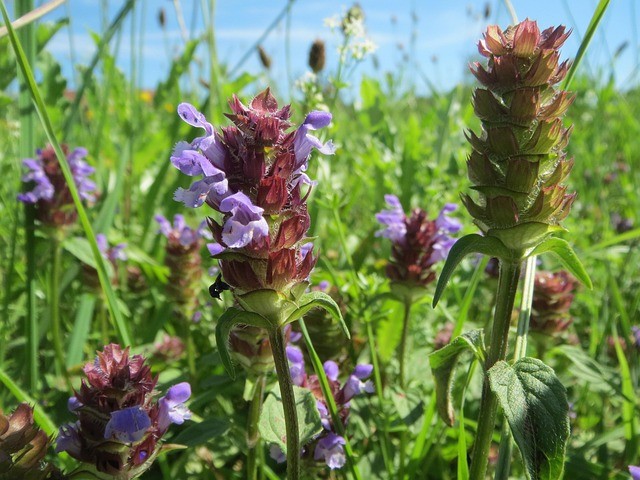
Common self-heal
Prunella vulgaris
A low, creeping perennial of the mint family, forming mats in short grass and flowering from a squat, oblong head of violet two-lipped flowers packed between purplish-green bracts. The stems are square and the leaves paired and oval. Leaves and flower heads are mild and slightly astringent, used fresh in small quantities in salads or dried for tea, and the plant has a long history of traditional use as a wound and gargle herb.
Short grassland of most kinds — lawns, churchyards, playing fields, meadow edges, woodland rides and coastal turf — on a wide range of soils, tolerating regular mowing by flowering on very short stems. Common and widespread throughout Britain and Ireland.
No known eating toxicity; leaves and flower heads are taken raw or dried for tea, though the flavour is bitter and astringent and better in small amounts. Most self-heal grows in mown lawns, verges and playing fields, so weigh herbicide treatment, dog fouling and traffic dust before picking. Anyone on prescribed medication may want to check before drinking it regularly.
Always use more than one reference to confirm a plant. You are responsible for what you choose to forage.
Flower head
A dense, squat, oblong head 2–5 cm long at the top of the stem, with violet two-lipped flowers pushing out a few at a time from between overlapping purplish bracts. The head stays intact and turns brown after flowering, so it can still be found in autumn — quite unlike the separated whorls of flowers spaced up the stem in the dead-nettles.
Stem cross-section
Square in section, often flushed red, with sparse hairs on the angles. Rolling it between finger and thumb gives four distinct edges, placing it in the mint family before any flower is seen.
Leaves
Opposite pairs on short stalks, oval to lance-shaped, untoothed or with a few shallow teeth, and slightly hairy. Crushing them releases no scent at all, which rules out the mints, balms and wild marjoram growing in the same rough grass.
Growth habit
Creeps by stems that root where they touch the ground, making low patches. In mown turf it flowers at 5 cm or less; in longer grass it stands up to 30 cm.
Updated 2026-08-07T20:41:51.983Z · Part of the shared Foragers Log catalogue · Herb