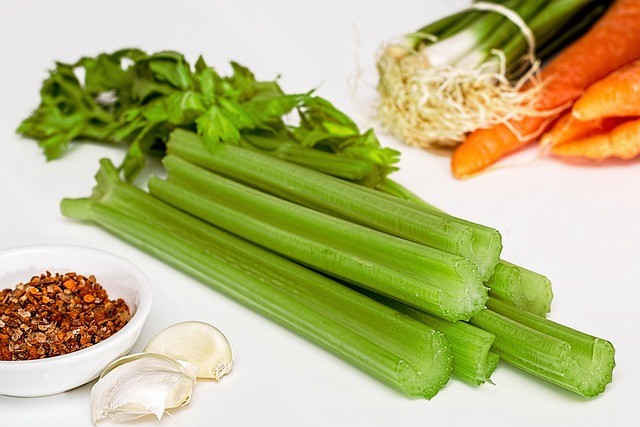
Celery
Apium graveolens
A strongly aromatic biennial umbellifer with glossy, coarsely toothed pinnate leaves on grooved, ribbed stems, throwing up small greenish-white umbels in its second year. The wild plant of coastal ditches is the ancestor of cultivated celery and celeriac; it is ranker and more bitter than the blanched crop, but leaf, stalk and ripe seed all carry the same celery flavour.
Brackish ground near the sea: ditch banks, sea walls, the upper edges of saltmarsh and grazing marsh, mainly in southern and eastern England with scattered coastal records in Wales and Ireland. Also widely grown in gardens and as a field crop well inland.
Celery is a recognised and sometimes severe food allergen, and the sap carries furanocoumarins that can blister skin exposed to sunlight, so cover arms when handling plants in quantity. Wild plants grow in wet ditches alongside Hemlock Water-dropwort (Oenanthe crocata), which is deadly and has a cluster of pale parsnip-like tubers and no celery smell when a leaf is crushed. Hemlock (Conium maculatum) is also deadly and shares damp margins; its stems are smooth and purple-blotched rather than deeply ribbed, and it smells mousy, not of celery. Avoid ditches carrying road or farm run-off.
Always use more than one reference to confirm a plant. You are responsible for what you choose to forage.
Smell when crushed
A crushed leaf or stem gives an unmistakable, concentrated celery smell. If there is no celery smell, do not pick it: neither Hemlock Water-dropwort nor Hemlock smells of celery, and this single test settles most identifications in a wet ditch.
Stems
Green, solid at the base and deeply grooved and ribbed along their length, with no purple spotting or blotching. Hemlock's stems are smooth, hairless and marked with purple blotches.
Leaves
Glossy, deep green and pinnate, the leaflets broadly diamond-shaped or three-lobed with coarse teeth, carried on a clear stalk. Hemlock Water-dropwort's foliage is much more finely divided and matt rather than shining.
Flowers
Small, greenish-white umbels only a few centimetres across, often short-stalked and tucked among the upper leaves, with few or no bracts. The white umbels of Hemlock Water-dropwort are broad, flat and far more conspicuous.
Root
A tough, fibrous rootstock, sometimes slightly swollen but never a cluster of fleshy fingers. Hemlock Water-dropwort has a bunch of pale, parsnip-like tubers, and these are the most poisonous part of that plant.
Updated 2026-08-07T20:37:39.372Z · Part of the shared Foragers Log catalogue · Vegetable