Celeriac
Apium graveolens rapaceum
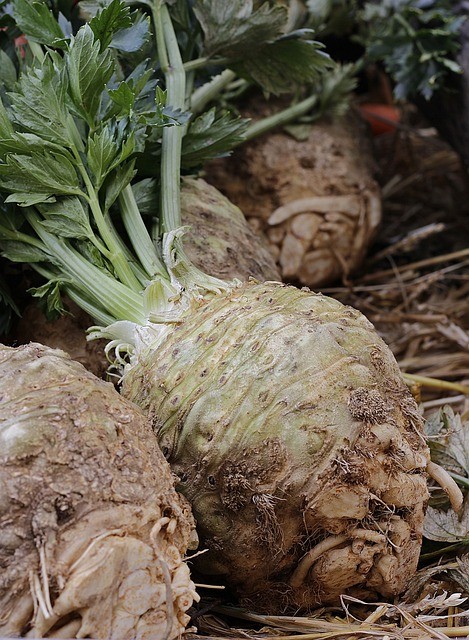
A cultivated form of celery grown for its swollen stem base rather than its stalks. The crown forms a rough, knobbly, buff-brown globe sitting at soil level, 8–12 cm across, topped by a rosette of dark green, divided leaves on ribbed stalks. The off-white flesh is firm and strongly celery-scented, used in soups and mashes, roasted, or shredded raw into remoulade. A biennial, grown as an annual and lifted in its first autumn and winter.
A garden and allotment crop across Britain and Ireland, needing deep, fertile, moisture-retentive soil in an open site and a long season from an early indoor sowing. It does not persist or naturalise here; the wild parent, celery, is a plant of brackish coastal ditches and saltmarsh edges instead.
Celery is one of the declared food allergens in UK labelling rules, and celeriac carries the same proteins — reactions in sensitive people can be severe, including to cooked root. The foliage and peel contain furanocoumarins, so handling large quantities in sunlight can cause a burning skin rash; levels are higher in plants with pink rot, whose brown-streaked roots are best discarded. As a sown crop harvested where it was planted, identity is rarely in question.
Always use more than one reference to confirm a plant. You are responsible for what you choose to forage.
Swollen crown
A roughly globose, knobbly swelling 8–12 cm across, buff to grey-brown, scarred where side roots are trimmed away. It sits at soil level as a thickened stem base rather than tapering into the ground like a parsnip or carrot root.
Leaves
Dark green and glossy, divided into coarsely toothed leaflets on ribbed, slender stalks. The stalks stay thin and stringy — they never thicken into the fleshy blanched ribs of stalk celery, which is the quickest way to tell which crop you are looking at.
Smell of a crushed leaf
Crushing a leaflet gives a strong, unmistakable celery scent. A rosette of similar divided leaves with no celery smell is not this plant.
Cut flesh
Firm and off-white, close-textured with no distinct core, and it browns quickly once exposed; drop peeled pieces into acidulated water if appearance matters. Brown streaks or soft grey patches inside indicate pink rot rather than normal ageing.
Second-year growth
Plants left in the ground past late winter bolt, sending up a branched stem with flat umbels of tiny greenish-white flowers. Once this starts the crown becomes woody and pithy and is no longer worth lifting.
Updated 2026-08-07T21:15:24.631Z · Part of the shared Foragers Log catalogue · Vegetable