Calendula
Calendula officinalis
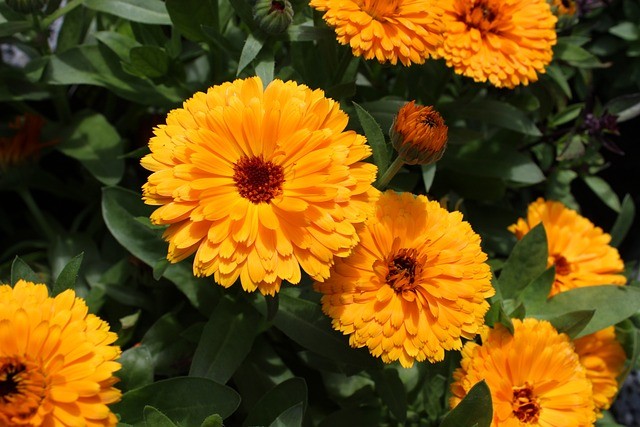
A cultivated annual daisy with bold orange or yellow flowerheads 4–7cm across, carried on sprawling, sticky-hairy stems above pale, untoothed, spoon-shaped leaves. It flowers almost continuously from early summer to the first frosts. The ray florets are picked fresh to scatter through salads, or dried to colour rice, soups and butter, where they give a faintly resinous, bitter warmth rather than sweetness.
A Mediterranean garden plant in Britain and Ireland, grown in beds, allotments and vegetable plots and turning up as a casual on tips, roadsides, waste ground and disturbed soil near houses. Wants open, sunny ground and self-seeds readily, but rarely persists as a settled population.
Petals and young leaves are eaten in small amounts with no reported toxicity, though the resinous, bitter flavour limits how much anyone uses. As a member of the daisy family it can provoke contact dermatitis or a reaction in people sensitive to Asteraceae such as chamomile or ragweed. Plants bought as bedding are frequently treated with pesticides, so grow from seed where the flowers are for eating.
Always use more than one reference to confirm a plant. You are responsible for what you choose to forage.
Flowerhead
A single flowerhead 4–7cm across on each stem tip, the ray florets uniformly orange to pale yellow and the central disc the same colour or slightly browner. Garden marigolds (Tagetes) that share the name have several smaller heads per branch and finely divided, strongly pungent foliage.
Leaves
Alternate, pale green, oblong to spoon-shaped and softly hairy, with untoothed or only faintly toothed margins. The lower leaves narrow to a short stalk while those up the stem sit stalkless and part-clasping, so the stem appears to pass through them.
Stem and texture
Stems are angular, brittle and sprawling rather than upright, often flopping outward as the plant ages. Everything above ground feels slightly tacky to the touch, and crushed foliage leaves a resinous smell on the fingers.
Seeds
After flowering the head produces a ring of curved, C-shaped achenes with ridged or warty backs and no parachute of hairs. That single feature separates the genus from dandelions, sow-thistles and other yellow-flowered daisies whose seed heads blow away as down.
Updated 2026-08-08T06:52:56.305Z · Part of the shared Foragers Log catalogue · Herb