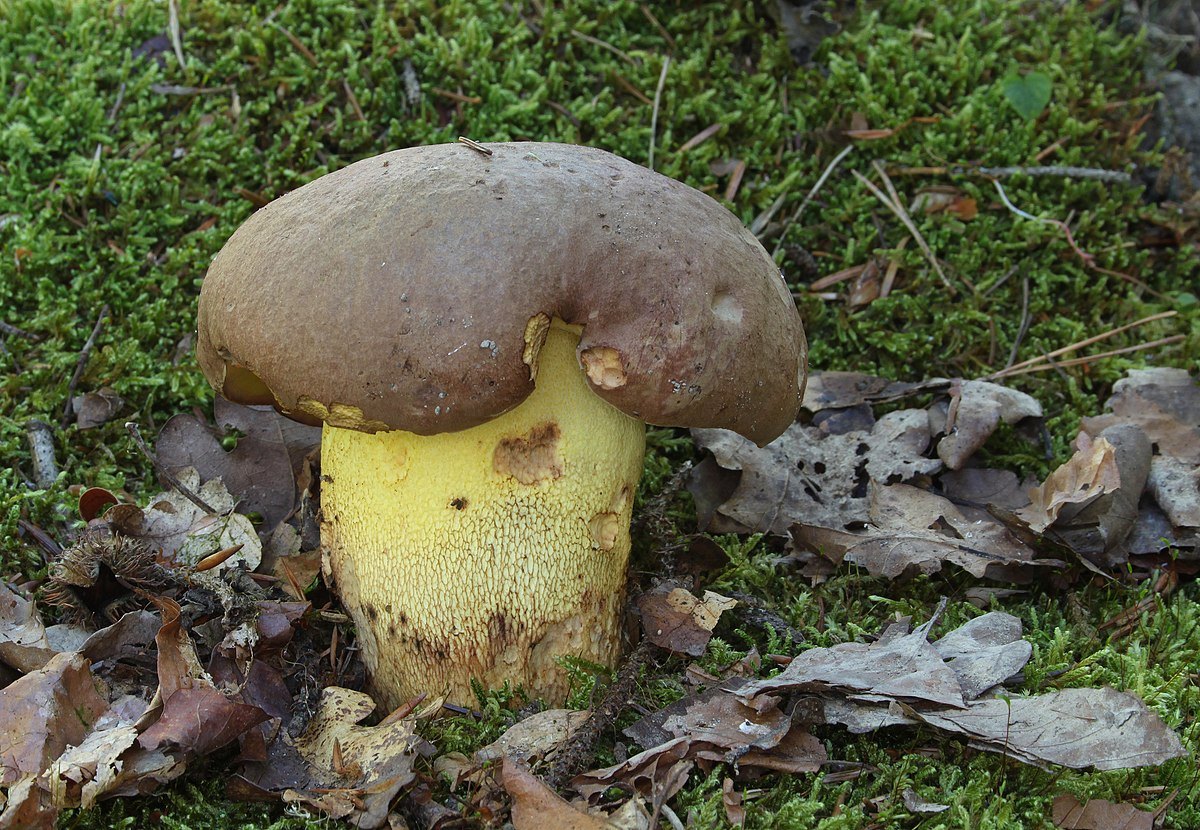
Butyriboletus appendiculatus
Butyriboletus appendiculatus
A stout, firm bolete with a warm tan to hazel-brown cap, chrome-yellow pores and a yellow stem finely netted over its upper half, tapering to a rooting base. The pale yellow flesh blues faintly when cut, most noticeably just above the tubes. The taste is mild and nutty, and it is treated as a good edible where it is plentiful, though in Britain it is an uncommon find of southern broadleaved woodland.
Mycorrhizal with broadleaves, chiefly oak and beech, on warm, well-drained calcareous soils. Turns up on woodland edges, wood banks and parkland rides, mainly in southern England and scarce or absent further north.
Edible when thoroughly cooked; boletes should not be eaten raw. Bitter Beech Bolete (Caloboletus radicans) shares the same oak and beech woods and is inedibly bitter — its cap is grey-buff rather than warm tan, and a trace of raw flesh on the tongue is sharply bitter rather than mild. Devil's Bolete (Rubroboletus satanas) also favours chalky broadleaved woodland and blues when cut, but has a pale off-white cap with orange-red pores and a red-flushed, red-netted stem. Uncommon in Britain, so consider leaving small fruitings.
Always use more than one reference to confirm a plant. You are responsible for what you choose to forage.
Cap
6–20 cm across, warm tan, hazel or bay-brown, dry and slightly velvety, often finely cracked in dry weather. The colour is even and warm rather than the grey-buff of the bitter beech bolete.
Pores and tubes
Bright chrome-yellow and very fine, bruising blue-green within seconds of being pressed. Yellow pores rule out the penny bun group; orange or red pores rule this species out entirely.
Stem
Yellow, club-shaped, covered in a fine yellow network over the upper half and tapering to a rooting, pointed base that is often flushed rust or brownish. No red netting at any point.
Flesh and taste
Pale butter-yellow, blueing faintly above the tubes and in the stem apex. A crumb touched to the tongue and spat out is mild and nutty — any strong bitterness means a different bolete and the collection should be abandoned.
Updated 2026-08-08T12:03:03.051Z · Added 2025-08-24T09:51:26.659Z
Part of the shared Foragers Log catalogue · Fungus