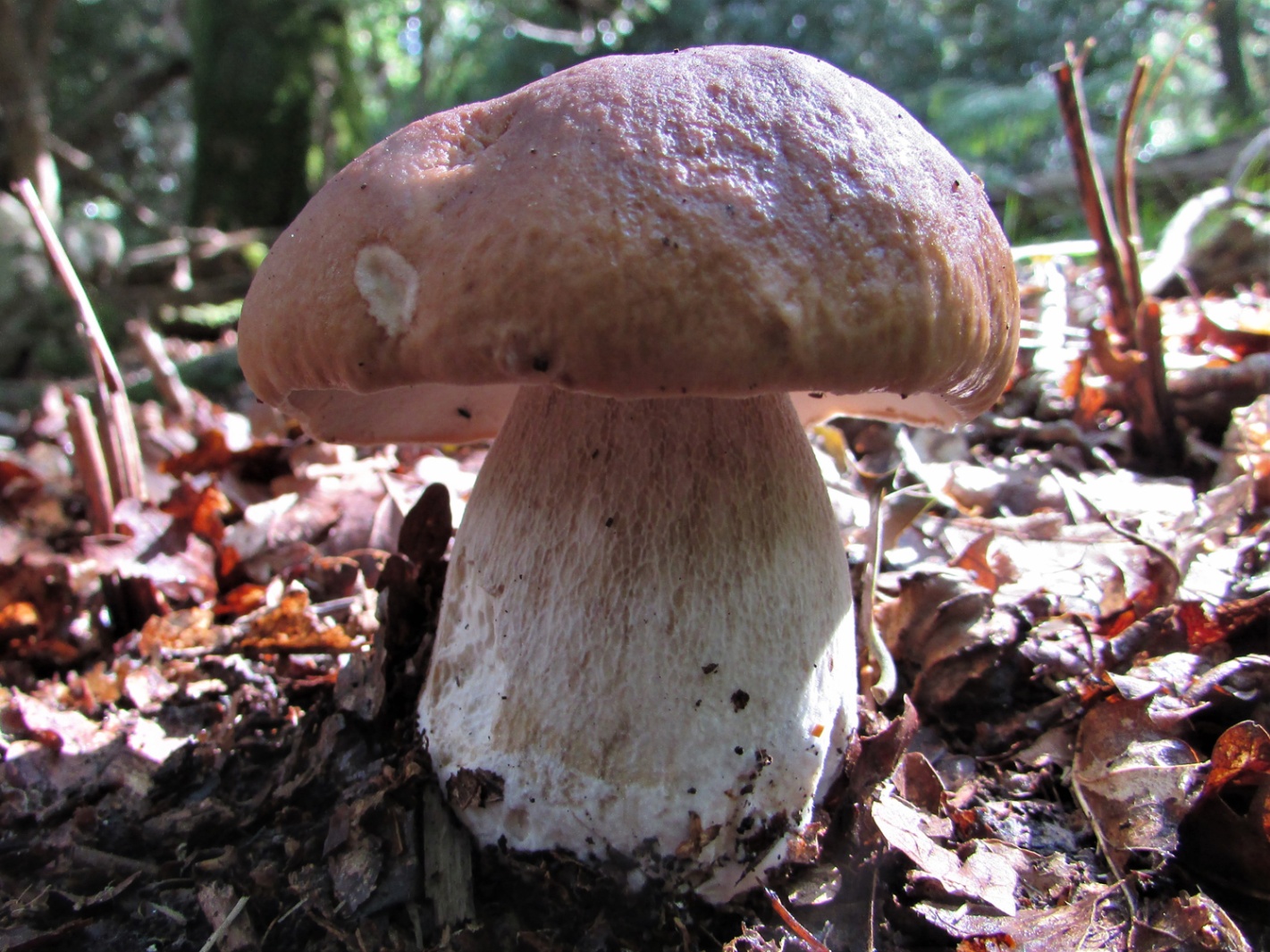
King Bolete
Boletus edulis
A heavy, thick-set bolete with a tan to chestnut-brown cap, a spongy layer of tubes instead of gills, and a stout pale stem marked with a fine raised net near the top. The flesh is white and stays white when cut, firm and nutty in young fruitbodies. Long valued in the kitchen fresh, and one of the best wild fungi for drying, which concentrates the flavour.
Mycorrhizal, forming partnerships with both broadleaves and conifers — most often beech, oak, birch, Scots pine and spruce. Favours well-drained sandy or acidic soils, appearing along woodland tracks, rides and grassy edges rather than deep shade. Widespread throughout Britain and Ireland.
Generally eaten cooked; thin raw slices are a traditional use but raw boletes disagree with some people, and older caps are usually riddled with fly larvae. Bitter Bolete (Tylopilus felleus) is the common mistake — its pores flush pink with age and its stem net is dark on a paler ground, and a fragment on the tongue is harshly bitter where this species is mild and nutty. Devil's Bolete (Rubroboletus satanas), found on chalk in southern England, has red to orange pores and a red-flushed stem that bruises blue; the pores here are white to olive and never blue. Avoid collecting from roadsides and heavily used verges.
Always use more than one reference to confirm a plant. You are responsible for what you choose to forage.
Cap
Tan through chestnut to deep red-brown, 8–25 cm across, smooth and slightly greasy-looking when damp. The margin often stays noticeably paler, almost white, and the surface is neither velvety nor cracked into a mosaic.
Pore surface
A spongy layer of fine tube mouths, white in young fruitbodies, ageing cream then olive-yellow, and peeling away from the cap flesh in one mat. Press it firmly: no blue or red flush should develop. Any bluing, or pores that are red or orange, rules this species out.
Stem
Stout, often swollen or club-shaped at the base, off-white to pale buff, with a fine white raised net over the upper third. The net is paler than the stem beneath it — a dark net on a pale stem points to Bitter Bolete instead.
Flesh and taste
White and unchanging when cut, firm and dense in young caps, cottony in old ones. A small raw fragment held on the tongue and spat out tastes mild and nutty; bitterness or acridity means a different bolete, whatever the cap colour suggests.
Updated 2026-08-08T12:03:03.364Z · Part of the shared Foragers Log catalogue · Fungus