White mulberry
Morus alba
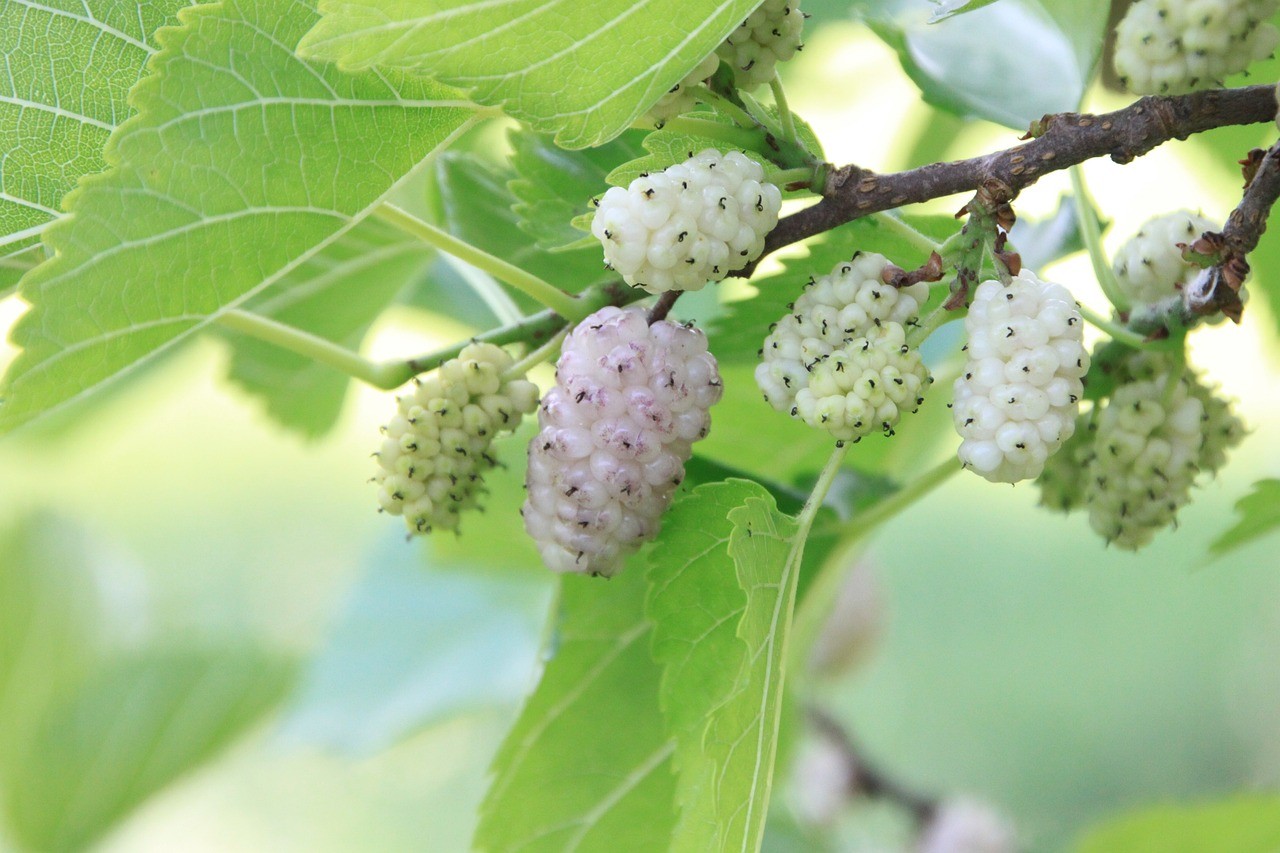
A deciduous tree reaching around 15 m, with thin, glossy leaves that vary widely even on the same branch, from plain heart shapes to deeply lobed mittens. The fruit is a small aggregate of drupelets, white, pink or deep purple when ripe, sweet and low in acid rather than sharp. Introduced as silkworm fodder, it is eaten fresh, dried, or cooked into jams and syrups.
Planted rather than truly wild in Britain: gardens, churchyards, parks, city streets and the remains of old silk-industry plantings, mostly in southern and eastern England. It favours deep, well-drained soil and a warm, sheltered position.
Ripe fruit is safe to eat. Unripe fruit and the milky latex in leaves and twigs can cause stomach upset, and the sap irritates some skin, so wash your hands after picking. Trees along streets and car parks may carry traffic dirt or spray residue, and the juice stains badly.
Always use more than one reference to confirm a plant. You are responsible for what you choose to forage.
Leaf shape and surface
Leaves are thin, bright green and glossy above, hairless or nearly so, with toothed margins. Shape is unreliable as an identifier on its own — one tree carries unlobed hearts alongside two- and three-lobed mittens — but the glossy, smooth upper surface separates it from the dull, sandpapery leaves of black mulberry.
Fruit and stalk
An aggregate of soft drupelets 1–2.5 cm long, ripening white, pink or deep purple depending on the tree, and hanging on a slender stalk roughly as long as the fruit. The flavour is sweet and mild with little acidity.
Milky sap
A broken leaf stalk or young twig releases white latex within a few seconds. This confirms the mulberry family and is the same substance that makes unripe fruit unpleasant to eat.
Bark and habit
Orange-brown to pale grey bark with shallow fissures, on a tree that is typically upright and fast-grown. Old black mulberries are shorter, gnarled and often leaning on props, so overall form is a useful check from a distance.
Updated 2026-08-07T20:37:41.868Z · Part of the shared Foragers Log catalogue · Fruit