Black mulberry
Morus nigra
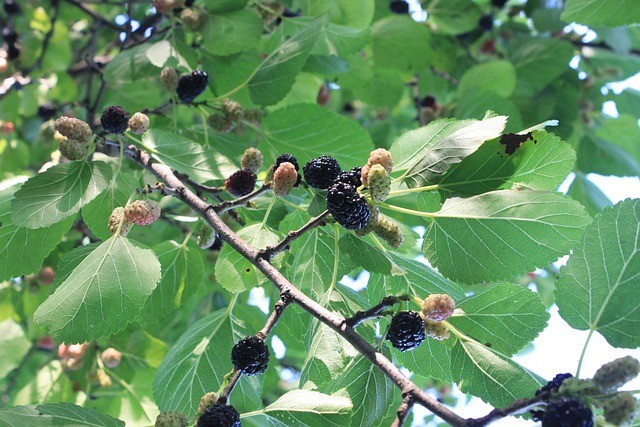
A spreading, often low-crowned deciduous tree with a gnarled, burred trunk and deeply fissured orange-brown bark, usually met as an old planted specimen rather than a wild tree. The leaves are thick and sandpapery to the touch, heart-shaped with a deep notch at the base, and come into leaf very late in spring. The fruit is an aggregate of drupelets about 2 cm long, ripening through green and red to deep purple-black, intensely juicy and sharply sweet. Eaten raw within minutes of picking, or cooked into pies, cordials and jams.
Not native to Britain and Ireland but planted since at least the sixteenth century, so found in walled gardens, churchyards, college grounds, old orchards and city parks, mostly in southern and central England. Prefers a warm, sheltered site on deep, well-drained soil; it self-seeds only rarely.
Ripe fruit is eaten raw without preparation. Unripe fruit and the milky sap that runs from broken leaf stalks and twigs can cause stomach upset and mouth irritation, and the sap irritates the skin of some people, so pick only fruit that is fully black and drops at a touch. The juice stains skin, clothing and paving permanently, and windfalls ferment quickly and draw wasps. Most trees are in private or institutional grounds, so ask before picking.
Always use more than one reference to confirm a plant. You are responsible for what you choose to forage.
Habit and bark
A broad, often leaning tree rarely above 10 m, with heavy low limbs that sometimes rest on the ground. The trunk is short, burred and knotty, with deeply fissured orange-brown bark. Nearly all British trees are planted, so a mulberry in a hedgerow is worth a second look.
Leaves
Thick and rough as fine sandpaper on the upper surface, softly downy beneath, heart-shaped with a deep notch at the base and blunt, rounded teeth. Vigorous young shoots may carry irregularly lobed leaves. A smooth, glossy, hairless leaf points to a different Morus.
Fruit
An aggregate of small drupelets, cylindrical and 2–2.5 cm long, sitting almost directly on the twig with no obvious stalk. It ripens green to red to a matt purple-black and is so soft when ready that it collapses between the fingers and bleeds dark red juice.
Milky sap
Snapping a leaf stalk or a young twig releases a white latex within a second or two. This places the tree in the fig family and rules out any of the rose-family fruit trees it might be planted beside.
Late leafing
Among the last trees in the garden to break bud, often bare into mid-May when the surrounding trees are in full leaf. Useful for spotting a mulberry from a distance in spring, long before there is any fruit to check.
Updated 2026-08-07T20:37:38.776Z · Part of the shared Foragers Log catalogue · Fruit