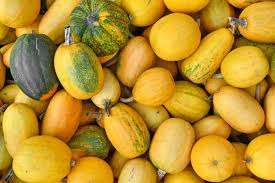
Squash
Cucurbita pepo
A sprawling, bristly annual with large lobed leaves on hollow, ridged stems, climbing or trailing several metres and carrying separate male and female yellow trumpet flowers. Fruit shape varies enormously between cultivars: courgettes, marrows, patty pans, acorn and spaghetti squashes are all the same species. Picked young the skin is soft and the whole fruit is eaten; left to mature it hardens into a storable rind.
A cultivated annual of gardens, allotments and polytunnels in the UK and Ireland, needing full sun, deep manured soil and warmth; the first frost kills the plant outright. Appears occasionally as a short-lived casual on compost heaps, tips and waste ground from discarded seed, but does not persist.
Flesh, seeds and flowers are safe cooked or raw when young. Occasional plants — usually seed saved from crossed garden squashes, or ornamental gourds — carry high levels of cucurbitacins and taste intensely bitter, which can cause violent vomiting and diarrhoea; spit out anything bitter and discard the whole fruit rather than cooking round it. The stiff hairs on stems and leaf stalks irritate skin, so pick with sleeves down.
Always use more than one reference to confirm a plant. You are responsible for what you choose to forage.
Stems and leaf hairs
Stems are angular, ridged and hollow, clothed in stiff bristles that catch on skin. The leaves are deeply lobed, often with silvery marbling along the veins — unlike the softer, rounder, barely lobed leaves and rounded stems of pumpkins in the Cucurbita maxima group.
Fruit stalk
The clearest species character, visible once a fruit has set: the stalk of Cucurbita pepo is hard and sharply five-angled. Cucurbita maxima has a thick, soft, corky round stalk, and Cucurbita moschata a stalk that flares outwards where it joins the fruit.
Male and female flowers
Male flowers sit on long slender stalks and appear first, often for a week or more before any fruit sets; female flowers sit close to the stem on a miniature fruit. Picking male flowers costs you nothing once several are open, but taking female flowers removes the squash.
Skin hardness test
Press a thumbnail against the skin. If it dents easily the fruit is a summer squash to eat within days; if the nail slides off a dry, dull rind the fruit has matured for storage and the flesh will be denser and sweeter.
Updated 2026-08-08T12:03:27.915Z · Part of the shared Foragers Log catalogue · Vegetable