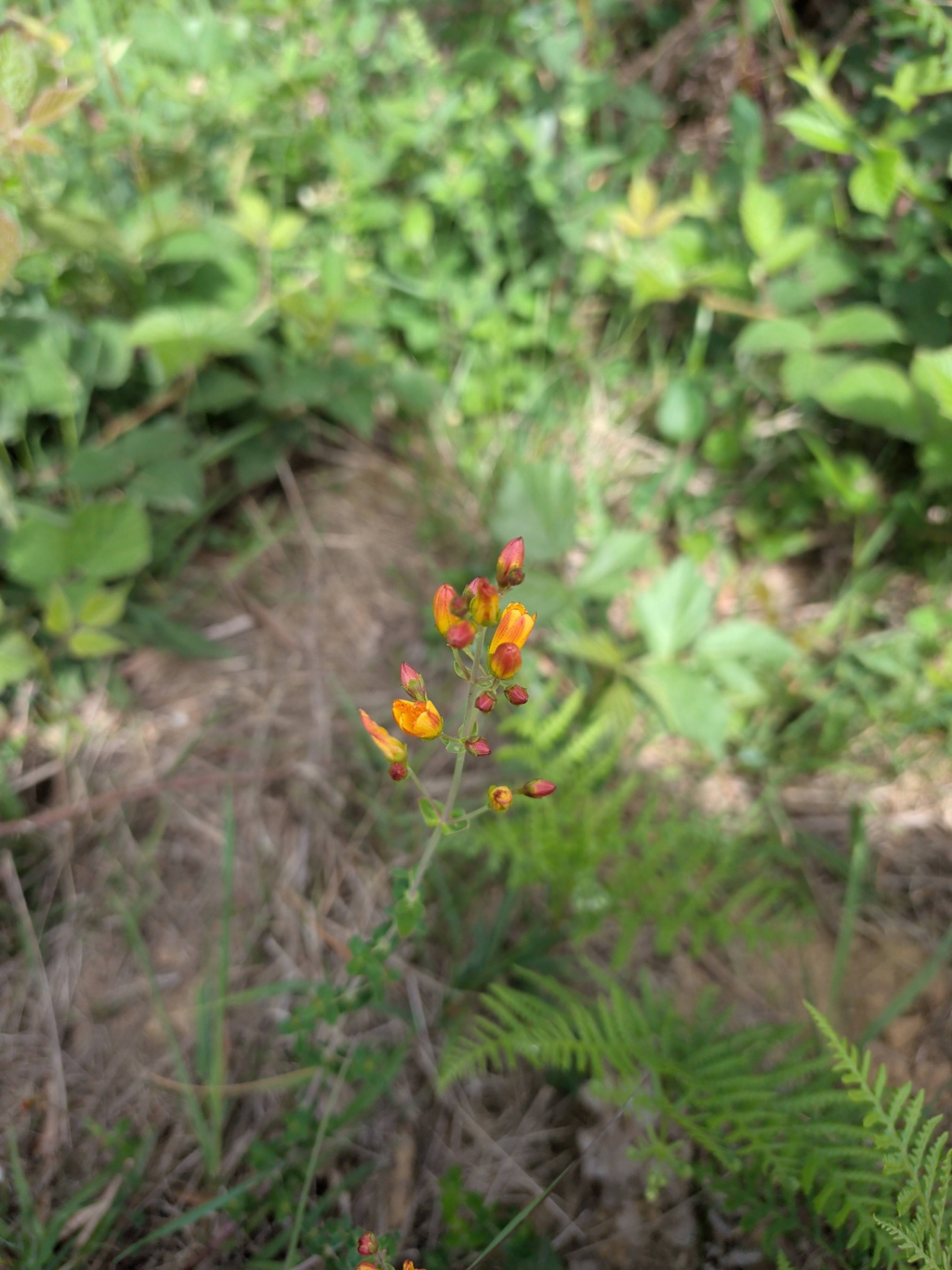
Slender St Johns Wort
Hypericum pulchrum
A slender, hairless perennial of acid ground, usually 20–50cm tall, with round wiry stems and small opposite leaves that are heart-shaped at the base and clasp the stem. The yellow flowers, about 15mm across, open from red-tinged buds, and the blunt sepals carry black stalked glands along their margins. It is the neatest and most upright of the native St John's-worts, and the one most closely tied to heath and thin acid soils.
Dry acid ground — heathland, upland grassland, banks, hedge bases and open birch or oak woodland, often on thin soils over rock. Widespread through Britain and Ireland but avoids lime, so it is scarce on chalk and limestone.
Not a documented food plant. Like other St John's-worts it contains hypericin, which is associated with photosensitivity — skin reactions in bright sun after ingestion — and the compounds in this genus are known to interact with prescription medicines including antidepressants and hormonal contraceptives. Several other yellow-flowered Hypericum species share its ground, so confirm the round unridged stem, clasping heart-shaped leaves and black-fringed sepals before picking anything.
Always use more than one reference to confirm a plant. You are responsible for what you choose to forage.
Habit
Slender and upright, few-branched, usually 20–50cm, with plants standing singly among heather and fine grasses rather than forming the dense leafy clumps of Perforate or Imperforate St John's-wort.
Leaves
Opposite, blunt, 5–15mm, broadly heart-shaped at the base and clasping the stem so each pair sits tight against it. Almost every other native St John's-wort has leaves that are stalkless but not clasping, and held out more or less flat.
Stem
Round and smooth in cross-section. Rolled between finger and thumb it has no ridges or wings, which separates it from Square-stalked St John's-wort (four wings) and Imperforate St John's-wort (two raised lines).
Flowers and buds
Petals yellow, the backs and the unopened buds flushed deep red. The sepals are blunt and fringed with short black stalked glands — a hand-lens check that no other slender heathland Hypericum in Britain matches.
Leaf glands
Held up to the light the leaves show scattered translucent dots, sparse and easily missed rather than the dense pin-prick perforations of Hypericum perforatum. A negative result here does not identify the plant on its own; use it alongside the clasping leaves.
Updated 2026-08-08T12:03:06.361Z · Added 2026-06-20T15:11:15.172Z
Part of the shared Foragers Log catalogue · Flower