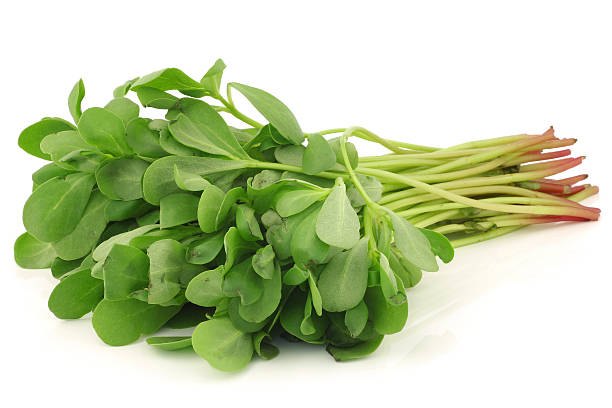
Purslane
Portulaca oleracea
A low, sprawling annual whose thick reddish stems radiate flat across bare ground from a central taproot, set with smooth, spoon-shaped succulent leaves gathered into rosettes at the stem tips. Tiny yellow flowers open only in bright sun. The shoots are crisp, juicy and faintly lemony, eaten raw in salads or briefly cooked, where their mucilage thickens a dish much as okra does.
Bare, sun-warmed, disturbed ground: allotment and garden beds, sandy arable margins, gravel and pavement cracks. In Britain and Ireland it is an introduced plant of warm, dry summers, scattered and mostly southern and eastern, and far commoner as an escape from cultivation than as a true wild colonist.
The leaves and stems are high in oxalic acid, so eat them in moderation, and cook rather than juice large quantities if you are prone to kidney stones or gout. Prostrate spurges (Euphorbia maculata and relatives) sprawl over the same bare ground, but their leaves are thin rather than fleshy and every broken stem bleeds milky white latex, where purslane runs with clear watery sap. Much of it grows in pavement cracks and cultivated beds, so avoid sprayed or heavily trafficked ground.
Always use more than one reference to confirm a plant. You are responsible for what you choose to forage.
Growth habit and stems
Stems are smooth, hairless and often flushed red or purple, thick and brittle, radiating outwards from one central rooting point to form a flat mat rarely more than 30 cm across. Snapped stems release clear watery sap, never a milky one.
Leaves
Flat, thick and paddle-shaped, 1–3 cm long with a blunt or slightly notched tip, hairless and slightly glossy. They are alternate along the stem but bunch into a rosette at each stem tip, which is where the pickable growth is.
Flowers
Very small, yellow, with five notched petals, sitting stalkless in the leaf clusters at the stem tips. They open for only a few hours in bright morning sun, so on a dull day a flowering plant can look as though it has none.
Seed capsule
The fruit is a small rounded capsule that splits all the way round like a lidded pot, the top lifting off to spill dozens of tiny glossy black seeds. Once seen it is the quickest confirmation of identity.
Taste and texture
A raw leaf is crunchy then slippery, mildly salty and sour like sorrel or lemon. Any burning, peppery or acrid heat in the mouth means the plant is not purslane; spit it out and start again.
Updated 2026-08-08T07:14:25.170Z · Part of the shared Foragers Log catalogue · Vegetable