Oregon-grape
Mahonia aquifolium
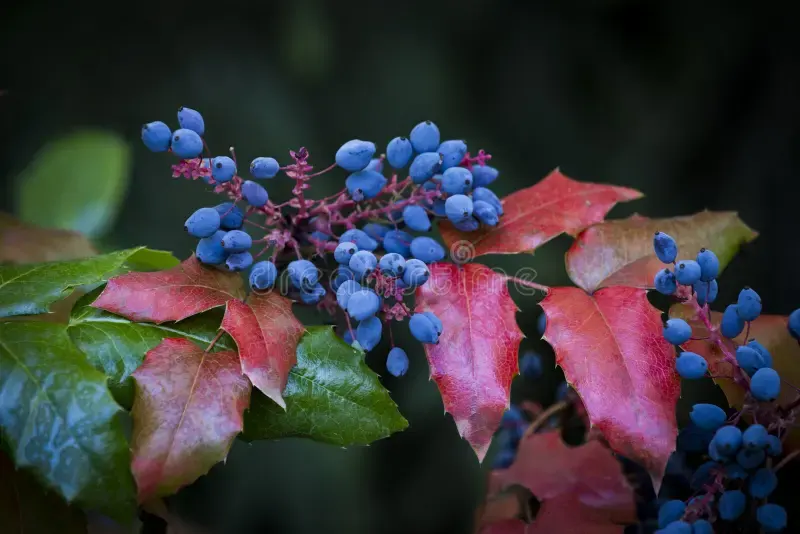
A stiff evergreen shrub, usually knee to shoulder height, with pinnate leaves of glossy, spine-toothed leaflets that flush bronze in cold weather. Dense spikes of bright yellow flowers open in late winter and spring, followed by tight bunches of blue-black berries dusted with a grey bloom. Planted everywhere in amenity landscaping and now thoroughly naturalised. The berries are sharply sour and rich in pectin, so they suit jellies, cordials and wine better than raw eating.
An introduced garden and landscaping shrub that spreads by suckers and bird-sown seed into woodland edges, plantation understorey, railway banks, churchyards and hedge bottoms. Tolerant of shade, dry soil and poor ground; most frequent around towns and old estate planting across lowland Britain and Ireland.
The berries are sour rather than sweet and are best cooked; the seeds are bitter, and a large quantity of raw fruit can be laxative for some people. Roots and inner bark are rich in berberine and are not food — traditional use of the root is medicinal rather than culinary, and pregnancy is a commonly cited caution. Stems and leaf teeth are prickly enough to draw blood, and because most UK plants are amenity or garden planting, consider spraying, pavement grit and dog traffic before picking.
Always use more than one reference to confirm a plant. You are responsible for what you choose to forage.
Habit
A low, stiff evergreen shrub, typically 0.5–2 m, spreading into dense suckering patches from a shallow root system. Stands out in winter as solid glossy green under leafless trees.
Leaves
Pinnate, with roughly five to nine leathery leaflets ranged along a single stalk, each leaflet edged with sharp spiny teeth. The divided leaf is the quickest separation from holly, which has one undivided leaf per stalk; leaflets often turn bronze or red in hard frost.
Flowers
Dense, upright clusters of small bright yellow six-parted flowers at the stem tips, opening from late winter through spring and faintly scented. Among the earliest nectar sources in urban planting.
Berries
Oval, about 8 mm, blue-black beneath a pale grey bloom that rubs off, held in tight grape-like bunches. Flesh is purple, staining, and sour, with two or three large seeds; a bunch of ripe fruit hangs heavy enough to bend the stalk.
Yellow inner wood
Scrape a stem or root and the wood beneath the bark is vivid yellow from berberine. A useful confirmation that you have a Mahonia or Berberis rather than a holly or other evergreen with prickly leaves.
Updated 2026-08-07T21:05:45.784Z · Part of the shared Foragers Log catalogue · Fruit