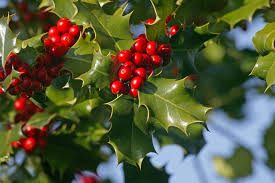
English holly
Ilex aquifolium
Eating this will make you ill. Listed here so you can recognise and avoid it.
A dense evergreen tree or shrub with thick, glossy leaves that are fiercely spined on the lower branches and often flat and almost spineless higher up the same plant. Male and female flowers grow on separate plants, so only some trees carry the scarlet berries, which ripen in autumn and persist well into winter. Gathered for winter greenery and hedging rather than for food.
Widespread in the understorey of oak and beech woodland throughout Britain and Ireland, and in old hedgerows, churchyards and parks. Tolerates deep shade and thin, dry soils, and is often the only evergreen shrub under a bare winter canopy.
The berries are the main risk: a small handful brings on vomiting and diarrhoea, and children and dogs are the usual casualties. No part of the plant has an established food use in the UK. The leaf spines are stiff enough to draw blood, so cut sprigs with gloves.
Always use more than one reference to confirm a plant. You are responsible for what you choose to forage.
Habit and bark
A conical shrub or small tree, usually 3–10m but occasionally to 15m, holding its leaves all year. Bark is smooth and pale grey, often with scattered warty bumps on older trunks.
Leaves
Thick, leathery and glossy dark green above, paler and matt beneath. Lower branches carry wavy leaves with stiff marginal spines; leaves out of browsing reach on the same tree are often flat and nearly spineless, so leaf shape alone is not a reliable guide.
Flowers and separate sexes
Small white four-petalled flowers, faintly scented, cluster in the leaf axils in May and June. Plants are male or female, so a holly that never fruits is not failing — it is simply male.
Berries
Round, scarlet and 6–10mm across, tight against the twig in the leaf axils of female plants from autumn onwards. Each holds several hard stones and the flesh is thin and bitter.
Updated 2026-08-07T20:46:06.549Z · Part of the shared Foragers Log catalogue · Fruit