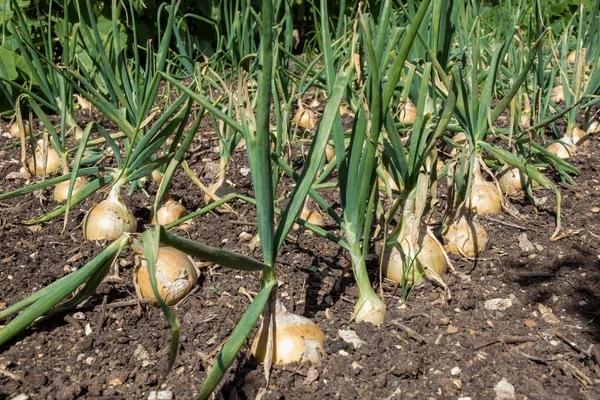
Onion
Allium cepa
A biennial allium grown as an annual for its swollen, layered bulb. Hollow, blue-green leaves rise from a short neck and flop over as the bulb fills; plants left a second year throw up a tall hollow stalk topped with a globe of small whitish flowers. Bulbs range from flat white to red and brown-skinned, and every part smells sharply of onion when cut. Grown worldwide as a kitchen staple and long naturalised in cultivation rather than in the wild.
A cultivated plant with no confirmed wild origin, grown across Britain and Ireland in gardens, allotments and field-scale beds on free-draining, fertile soil in full sun. It occasionally persists on old allotment ground, compost heaps and tips, but does not establish self-sustaining wild populations here.
Safe raw or cooked for most people, though raw onion irritates some stomachs and is restricted on low-FODMAP diets; cut bulbs release sulphur compounds that sting eyes and can irritate skin. Daffodil bulbs (Narcissus pseudonarcissus) have been mistaken for onions in kitchens and cause vomiting and cramps: a cut daffodil bulb has no onion smell and its layers are not the neat concentric fleshy rings of an onion. Onion is toxic to dogs, cats and horses, so trimmings should not be given to animals.
Always use more than one reference to confirm a plant. You are responsible for what you choose to forage.
Leaves
Hollow and round in cross-section, blue-green with a waxy bloom, arching from a short neck at ground level. Flat, solid, strap-shaped leaves point to leek or wild garlic rather than onion.
Bulb
A single swollen bulb of concentric fleshy layers under a dry papery tunic, sitting at or just above soil level. It is not divided into separate cloves, which separates it from garlic.
Flower head
In its second year a tall hollow stalk, swollen below the middle, carries a dense spherical umbel of small greenish-white star-shaped flowers. Flowering signals the bulb will not store well.
Maturity
The necks soften and the leaves fold over and yellow when the bulb has finished filling. Lifting before this happens gives a bulb that will not cure or keep.
Smell
Crushing any part releases a strong, sharp, sulphurous onion smell. No onion or garlic smell means the plant is not an allium at all, whatever the bulb looks like.
Updated 2026-08-07T21:15:30.559Z · Part of the shared Foragers Log catalogue · Vegetable