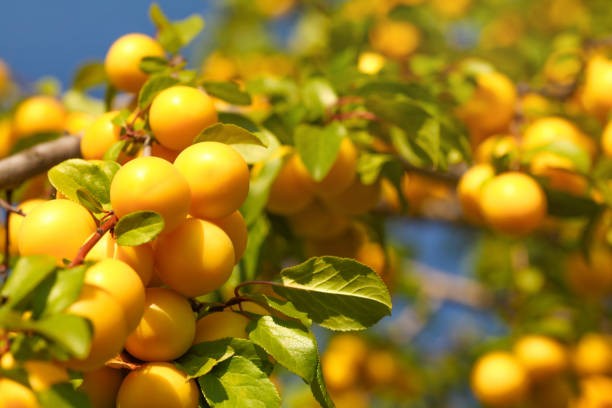
Mirabelle plum
Prunus domestica syriaca
A small, often suckering plum tree carrying round golden-yellow fruit 2–3 cm across, usually blushed red on the sunniest cheek, with sweet dense flesh and a stone that lifts away cleanly. Long grown in Lorraine and Alsace and planted in British gardens and orchards, from where it spreads into hedgerows. Eaten ripe from the tree, but at its best in jam, tarts and eau-de-vie.
Not native. Planted in orchards, gardens and shelter belts, and naturalised from suckers and discarded stones along hedgerows, lane sides and railway embankments. Prefers well-drained, sunny ground; scattered across southern and central Britain and much scarcer northwards.
The flesh is eaten raw or cooked with no special preparation. Do not crush or chew the kernels, which contain cyanogenic compounds as in other plums. Windfalls ferment fast and draw wasps, and hedgerow or roadside trees may carry traffic dirt or spray drift.
Always use more than one reference to confirm a plant. You are responsible for what you choose to forage.
Fruit
Round to very slightly oval, 2–3 cm, golden yellow with a red flush and often a faint bloom. The flesh is firm, sweet and yellow, and the small stone separates freely — unlike a cherry plum, whose flesh tends to cling.
Leaves
Obovate, matt mid-green, blunt-tipped and downy on the underside and midrib, 4–7 cm long. The dull, hairy surface is the quickest way to separate it from the glossy, hairless leaves of cherry plum.
Twigs and thorns
Young shoots finely downy, becoming grey-brown; short stiff side spurs may prick but there are no true rigid spines. Blackthorn, by contrast, is armed with long sharp thorns on almost every twig.
Flowers
White, about 2 cm across, in ones to threes on short spurs, opening in April with or just before the leaves. A tree in full flower on bare twigs in February is a cherry plum, not this.
Updated 2026-08-08T11:13:26.835Z · Part of the shared Foragers Log catalogue · Fruit