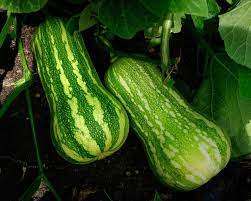
Marrow
Cucurbita pepo
A marrow is a courgette left to grow on: a frost-tender trailing or bushy annual that swells one fruit to 40 cm or more, with a hard striped rind and pale, watery, mild-tasting flesh. Grown for stuffing, baking and chutney, where the flesh carries the flavour of whatever it is cooked with rather than supplying much of its own.
Not a wild plant in Britain and Ireland. Grown on rich, well-manured allotment and garden beds in full sun, and often on compost heaps. Self-sown volunteers appear on compost and tipped garden waste, where the parentage of the seed is unknown.
The flesh is safe cooked, and safe raw when young. Any marrow that tastes bitter should be spat out and discarded: bitterness indicates high cucurbitacin levels, usually in fruit from saved or self-sown seed crossed with ornamental gourds, and eating it can cause severe vomiting and diarrhoea. The bristly leaves and stems can irritate bare arms when cutting fruit.
Always use more than one reference to confirm a plant. You are responsible for what you choose to forage.
Fruit
Cylindrical and smooth, 30–50 cm long, mid-green with paler longitudinal stripes or flushing creamy yellow with age. The rind resists a thumbnail — soft skin means it is still a courgette rather than a marrow.
Leaves and stems
Large triangular leaves with five shallow, toothed lobes, rough and bristly on both sides, borne on thick angular stems. The bristles are stiff enough to catch on skin, so cutting fruit is easier with sleeves down.
Flowers
Large funnel-shaped blooms in deep yellow-orange, up to 8 cm across. Male flowers sit on a long slim stalk; female flowers have a small swollen ovary immediately behind the petals, and only these go on to make fruit.
Flesh and seeds
Cut fruit shows pale, spongy, watery flesh around a soft central cavity packed with flat cream seeds. In a mature marrow the seed cavity is scooped out before cooking; in a courgette-sized fruit the seeds are still soft enough to eat.
Updated 2026-08-08T06:52:56.771Z · Part of the shared Foragers Log catalogue · Vegetable