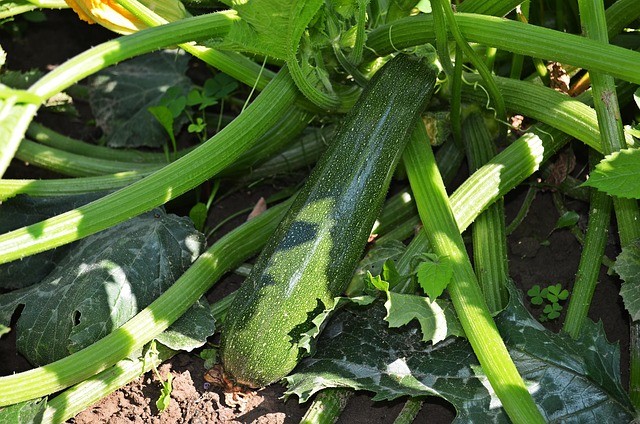
Courgette
Cucurbita pepo
A vigorous annual, usually bush-forming rather than long-trailing, with prickly hollow stems and large lobed leaves often marbled silver-grey along the veins. Grown for the immature fruit, cut glossy and smooth-skinned at finger to hand length before the seeds harden; the same fruit left on the plant swells into a marrow. The large yellow flowers are eaten too.
Not a wild British plant. Grown in gardens, allotments and polytunnels on rich, well-drained ground in full sun, and appearing as a short-lived casual on compost heaps, tips and disturbed soil where seed has been discarded. Frost kills it outright, so it does not persist.
Fruit that tastes bitter carries high levels of cucurbitacins and can cause violent vomiting and diarrhoea; spit it out and discard the whole fruit rather than trying to cook the bitterness away. Bitterness is most likely in plants raised from home-saved seed that has crossed with ornamental gourds. The prickly stems and leaf stalks irritate bare forearms.
Always use more than one reference to confirm a plant. You are responsible for what you choose to forage.
Habit
Forms a stout open bush a metre or so across, with the fruit held near the crown rather than running out along metres of stem. Trailing growth with fruit far from the base points to a squash or pumpkin instead.
Stems and leaves
Stems are hollow, ridged and covered in short stiff bristles that catch on skin. Leaves are broad and deeply five-lobed, frequently with pale silver-grey mottling between the veins, which is varietal marking and not mildew.
Flowers
Large trumpet-shaped orange-yellow flowers with pointed lobes. Male flowers sit on a long slender stalk and are the ones worth picking; female flowers have a miniature fruit already swelling directly behind the petals.
Fruit at picking size
Best cut at 10-20 cm, skin glossy and easily marked with a thumbnail, seeds still soft and barely formed. Dull skin that resists a nail and a hollow feel mean it has gone over to marrow.
Taste test
A raw sliver should be mild and faintly sweet. Any harsh bitterness means cucurbitacins are present; the fruit is not usable and the taste does not cook out.
Updated 2026-08-08T11:01:38.124Z · Part of the shared Foragers Log catalogue · Vegetable