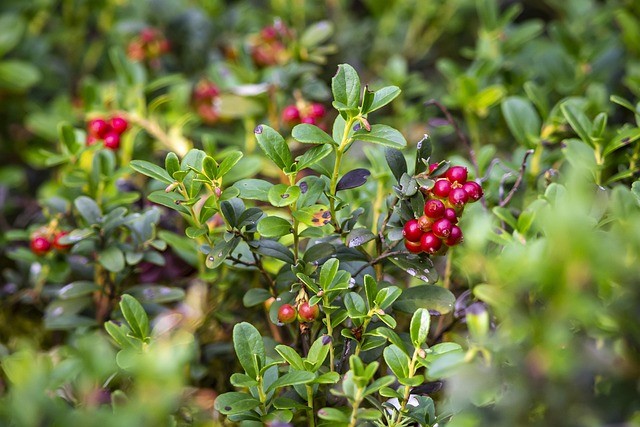
Lingonberry
Vaccinium vitis-idaea
A low evergreen dwarf shrub, rarely more than 20cm tall, spreading by creeping woody stems into dense mats. The small leathery leaves are obovate with slightly rolled edges, glossy dark green above and paler beneath with scattered dark bristly dots. Nodding bell-shaped flowers, white flushed pink, are followed by tight clusters of firm scarlet berries at the shoot tips. The fruit is sharp and astringent raw and is usually cooked into the sauces and preserves familiar from Scandinavia.
Acid, peaty ground on upland heath and moorland, and in open pine and birch woodland, usually growing among heather and bilberry. Widespread in the Scottish Highlands, thinning southwards through northern England, north Wales and parts of Ireland.
Edible raw but very sharp and astringent until cooked or frosted, and a large quantity of raw berries can leave the stomach uncomfortable. Check the leaf underside for the dark bristly dots before eating any red berry picked on moorland. Upland heath is tick country, so a tick check afterwards is worthwhile.
Always use more than one reference to confirm a plant. You are responsible for what you choose to forage.
Habit
An evergreen mat of creeping woody stems throwing up short upright shoots, seldom above 20cm. It keeps its leaves through winter, unlike the bilberry it often grows beside, which stands bare and green-stemmed from autumn to spring.
Leaf underside
Turn a leaf over: the paler underside is scattered with small dark brown bristle-like dots. This is the most reliable single character on the plant, and no other red-berried dwarf shrub on UK moorland shows it.
Leaf shape and texture
Obovate, 1–3cm, thick and leathery with a slightly notched tip and margins rolled under. Bilberry leaves by contrast are thin, bright green and finely toothed.
Flowers
Short terminal clusters of nodding, four-lobed bell-shaped flowers, white to pale pink, from late spring into summer. They sit above the foliage rather than hanging singly from leaf axils.
Berries
Clustered at the shoot tips, round, 6–10mm, glossy scarlet and firm to the squeeze. The taste is markedly acidic and drying in the mouth; the high acidity is why the fruit keeps so well.
Updated 2026-08-07T20:41:47.918Z · Part of the shared Foragers Log catalogue · Fruit