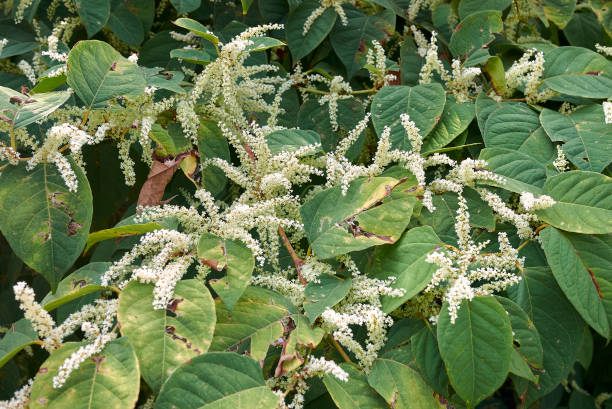
Japanese knotweed
Reynoutria japonica
A tall herbaceous perennial with hollow, bamboo-like canes speckled purple-red, zig-zagging between swollen nodes, and shield-shaped leaves with a flat base. Slender creamy panicles appear from the leaf axils in late summer. The spring shoots are the part foraged: crisp, hollow and sharply tart, cooked much as rhubarb is.
Forms dense stands on riverbanks, railway embankments, roadsides, waste ground and neglected gardens, on almost any soil. Naturalised throughout Britain and Ireland, mostly in the lowlands; it spreads by rhizome and stem fragments rather than by seed.
Edible cooked or raw but high in oxalic acid, as rhubarb is — eat in moderation, and take advice first if prone to kidney stones. Established stands are frequently sprayed, so leave canes that are stunted, yellowed or distorted. It is an offence under the Wildlife and Countryside Act 1981 to cause this plant to spread in the wild, and cut material is classed as controlled waste: pick only what you will eat and carry no fragments off site.
Always use more than one reference to confirm a plant. You are responsible for what you choose to forage.
Canes
Hollow, jointed and bamboo-like, reaching 2–3 m in a season, green flecked and streaked with purple-red, with a swollen node and papery sheath at each joint. Dead canes stand orange-brown through winter, which is the easiest way to find a stand out of season.
Leaf shape and arrangement
Broadly shield-shaped, 8–14 cm long, tapering to a point but with a distinctly flat, squared-off base rather than a heart-shaped notch. Borne singly at each node, alternating so the stem appears to zig-zag.
Spring shoots
Emerge as thick asparagus-like spears, reddish-purple and speckled, with the leaves still rolled at the tip. Hollow and crisp inside, snapping rather than bending, and sour to taste — the tartness is the confirmation once shape and node pattern agree.
Flowers
Loose sprays of tiny creamy-white flowers hanging from the leaf axils in late summer and early autumn, held along most of the upper stem rather than in a single terminal head.
Updated 2026-08-07T20:46:11.158Z · Part of the shared Foragers Log catalogue · Fruit