Hibiscus
Hibiscus
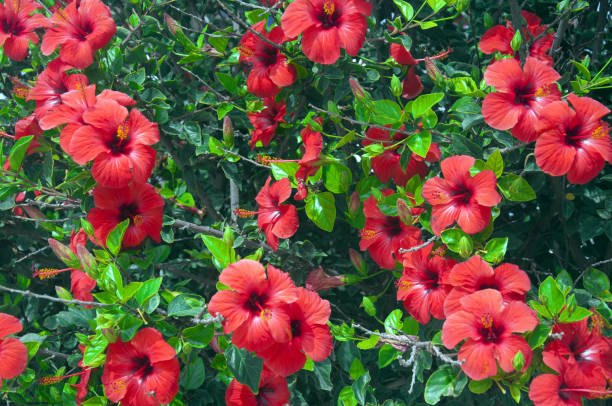
A genus of shrubs and herbaceous perennials grown for large, short-lived trumpet flowers, each with five broad overlapping petals and a long central column of fused stamens tipped by five knobbed stigmas. Leaves are alternate, toothed and often palmately lobed. Petals are used fresh in drinks and salads, and the swollen red calyces of roselle are the source of dried hibiscus tea.
No hibiscus is native to Britain or Ireland. Almost all UK material is planted: the hardy shrub Hibiscus syriacus in gardens, parks and car parks in the milder south and east, tender species under glass or as summer bedding. Plants found outside cultivation are garden escapes rather than established populations.
No hibiscus is known to be seriously toxic, and the flowers of several species are eaten, but food use is documented for only a handful of the several hundred species, so identify to species before eating. The stems and leaves of some species carry stiff bristly hairs that irritate skin. Ornamental plantings are often sprayed, and cultivated plants are not covered by the wild-plant picking exemption, so ask the owner first.
Always use more than one reference to confirm a plant. You are responsible for what you choose to forage.
Flower centre
A tube of fused stamens projects well beyond the petals, and the style emerges through it to end in five separate knobbed stigmas. Mallows share the staminal column but have many fine thread-like stigmas rather than five distinct heads.
Epicalyx and calyx
A ring of narrow bracts sits immediately beneath the green calyx. In roselle the calyx itself thickens and turns deep red after the petals drop; this fleshy cup, not the petal, is what is dried for tea.
Flower lifespan
Each bloom opens and collapses within a day, so a bush carries fresh flowers alongside spent twists of petal. Pick in the morning; by afternoon the same flower is limp and worth nothing in the kitchen.
Leaves
Alternate, toothed and carried on a clear stalk, usually with three to five palmate lobes, though narrow unlobed leaves occur in some species.
Fruit
A dry capsule that splits into five valves to shed the seeds, unlike the flat ring of nutlets, the so-called cheeses, left by common mallow.
Updated 2026-08-07T20:41:47.255Z · Part of the shared Foragers Log catalogue · Flower