Giant puffball
Calvatia gigantea
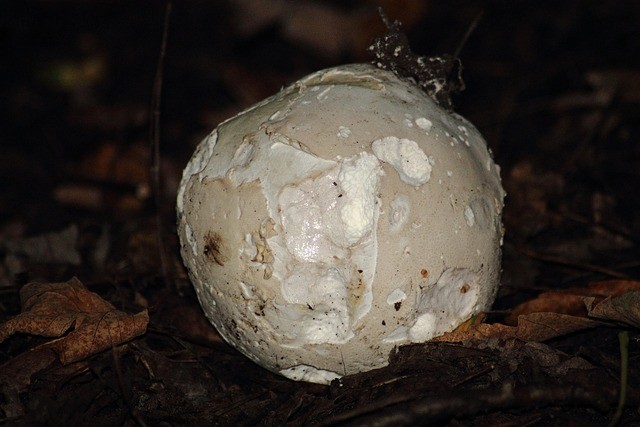
A white, near-spherical fruitbody the size of a football or larger, sitting on the ground without a stem and anchored by a single cord-like strand at the base. The skin is smooth and suede-like at first, the flesh inside uniformly white and firm; with age the interior yellows, then breaks down into olive-brown spore dust. Only the pure white stage is eaten, usually sliced thickly and fried.
Saprotrophic, living on rich soil rather than tree roots: nutrient-rich pasture, hedge banks, nettle beds, churchyards and woodland edges. Widespread but patchy across Britain and Ireland, and often fruiting in the same spot year after year.
Edible only while the flesh is uniformly white; once it yellows or turns olive it causes stomach upset, and the mature spore mass is not food. Halve every specimen before picking — a small unopened Death Cap egg (Amanita phalloides, deadly) shows a faint cap and gill outline in section, while puffball flesh is featureless throughout. Avoid heavily manured or roadside ground.
Always use more than one reference to confirm a plant. You are responsible for what you choose to forage.
Size and shape
A white ball 10–80cm across, spherical to slightly flattened, resting on the surface with no stem or ring. Anything with a stipe, cap or visible gills is not this species.
Skin
Smooth and kid-leather white when young, becoming felty and finely cracked with age, then discolouring ochre and brown before tearing open. Never scaly or ochre-brown from the start, which is how earthballs present.
Flesh in section
Cut every specimen from top to base. Good flesh is uniform, pure white and firm, like a dense marshmallow, with no cavity and no trace of a developing cap or gills.
Maturity
Old fruitbodies become light and hollow, filled with olive-brown spore powder that puffs out at a touch, and the collapsed skin can persist through winter. This stage is a useful field record but not an edible find.
Updated 2026-08-07T20:52:34.625Z · Part of the shared Foragers Log catalogue · Fungus