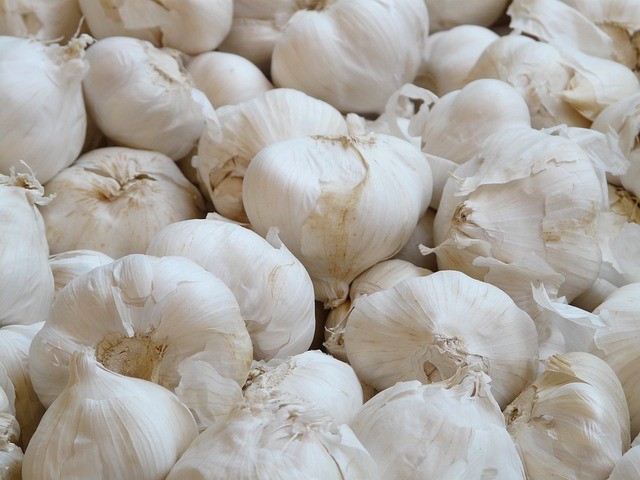
Garlic
Allium sativum
A cultivated allium grown for its underground bulb, which divides into several papery-skinned cloves rather than forming a single onion. The leaves are flat, keeled and grey-green, rising in a fan from a false stem of sheathing leaf bases, and hardneck types send up a coiled flower stalk, or scape, in early summer. Every part smells strongly of garlic when crushed.
Not native to Britain and only rarely persisting outside cultivation, where it appears on allotment edges, tips and waste ground close to gardens. It wants an open, sunny site with free-draining soil; it rots in cold wet ground and bulbs poorly in shade.
Safe as food for most people, though raw garlic in quantity irritates the stomach and can cause contact dermatitis in people who handle it repeatedly. Garlic held in oil should be refrigerated and used quickly, as home-made garlic oils have been linked to botulism. It is also toxic to dogs and cats.
Always use more than one reference to confirm a plant. You are responsible for what you choose to forage.
Bulb structure
Splits into roughly four to twenty cloves, each wrapped in its own papery skin beneath a shared outer wrapper. A single undivided bulb built of concentric layers is an onion, not garlic.
Leaves
Flat, folded along the midrib and grey-green, held in a two-ranked fan. Onion and chive leaves are hollow and round in cross-section, so a leaf that collapses when pinched is not this plant.
Scape
Hardneck cultivars throw one stiff stalk that coils a turn or two before straightening, tipped with a pointed sheath. Softneck types rarely flower in Britain, which is why they keep longer in store.
Flowerhead
Where it does flower the head carries small pinkish-white flowers mixed with, or wholly replaced by, tiny bulbils. Viable seed is almost never set.
Smell
Crushing any part releases the unmistakable garlic sulphur smell. No smell at all means the plant is not an allium and should be left.
Updated 2026-08-07T20:41:48.302Z · Part of the shared Foragers Log catalogue · Fruit