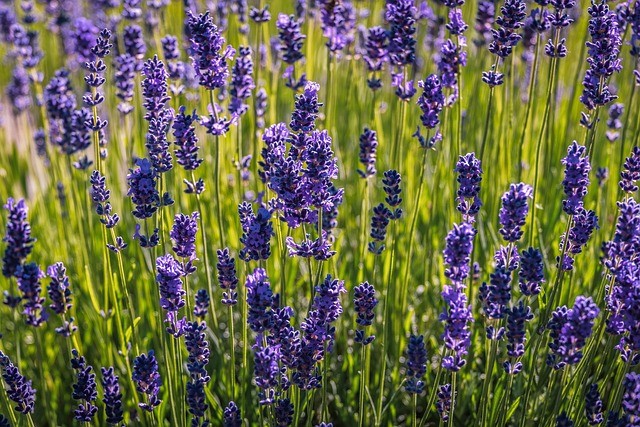
English lavender
Lavandula angustifolia
A low, domed evergreen shrub with woody lower stems, narrow grey-green leaves and short, dense spikes of violet-blue flowers held well clear of the foliage on slender, leafless stalks. The whole plant is strongly aromatic when brushed, sweet and clean rather than camphorous. The flowers are used fresh or dried in baking, sugars, syrups and infusions, where a very small quantity carries a long way.
A Mediterranean shrub of dry, sunny, free-draining ground, particularly chalk and limestone. In Britain and Ireland it is a garden and amenity planting that persists and self-sows locally on walls, banks, verges and dumped soil near habitation.
Flowers and leaves are safe in food in the small quantities anyone would want to use; the flavour turns soapy and bitter long before the amount becomes a concern. Undiluted lavender essential oil is a concentrated product and is not for swallowing. Handling the foliage can irritate sensitive skin, and garden, verge and municipal plantings are often sprayed or treated.
Always use more than one reference to confirm a plant. You are responsible for what you choose to forage.
Habit
A compact, rounded sub-shrub, usually 30–60cm tall, woody and grey-barked at the base with soft green growth above. It holds its leaves through winter, so the skeleton of the bush is visible year round rather than dying back to the ground.
Flower spike
A short, dense, blunt-ended spike of violet-blue flowers on a long, slender, unbranched and leafless stalk. There is no tuft of enlarged coloured bracts at the tip of the spike; that tuft marks out French lavender, Lavandula stoechas, which is a poor culinary substitute.
Leaves
Narrow, strap-shaped and untoothed, 2–5cm long, with slightly inrolled margins and a fine grey down that makes young growth look silvery. Toothed or finely divided leaves indicate one of the ornamental lavenders rather than this one.
Stem
Square in cross-section, as expected in the mint family, and woody only in the lower part. Rolling a flowering stem between the fingers is a quick way to confirm the family before any scent test.
Scent on crushing
Sweet, clean and floral with very little camphor. A sharp, medicinal, camphorous note usually means lavandin, the hybrid Lavandula × intermedia grown for oil and hedging, which is edible but coarse in the kitchen.
Updated 2026-08-07T20:46:12.620Z · Part of the shared Foragers Log catalogue · Flower