Echinacea
Echinacea purpurea
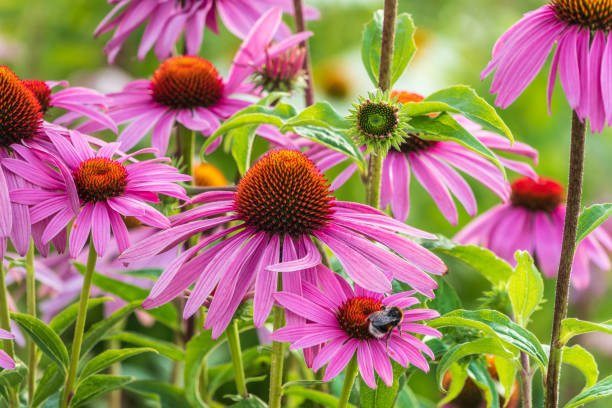
A stiff prairie perennial, 60–120cm tall, with rough-hairy ridged stems each carrying a single large flowerhead: a domed, bristly orange-brown cone ringed by purple-pink ray florets that hang downwards as the head opens. Leaves are coarse, toothed and sandpapery to the touch. Widely grown in UK gardens, where the flowering tops and the roots are dried for tea.
A plant of prairie and open oak woodland in central and eastern North America, not a British wild species. In Britain and Ireland it grows in sunny, well-drained garden borders and allotments, and turns up on verges, tips and neglected gardens as a throw-out rather than a naturalised coloniser.
No recorded eating-toxicity, but it is a daisy-family plant and people sensitive to Asteraceae — ragweed, chamomile, feverfew — can react to the flowers with rash or swelling. Garden and border plants may have been sprayed or fed. Anyone pregnant, on prescribed medication, or with an autoimmune condition may want to take advice before drinking it regularly.
Always use more than one reference to confirm a plant. You are responsible for what you choose to forage.
Flowerhead
One large head per stem tip, the purple-pink ray florets swept downwards below the horizontal around a raised central cone. The drooping rays and the proud cone are visible from several metres and rule out the flat-faced white heads of an oxeye-type daisy.
Central cone
Domed, orange-brown and stiffly bristly, prickly enough to feel it when you close your hand over it — the feature the name refers to. Garden Rudbeckia, the commonest mix-up, has a darker brown-black cone and yellow rays.
Leaves
Broad, ovate to lance-shaped, coarsely toothed and rough-hairy on both surfaces, the lower ones up to 15cm on winged stalks and becoming near-stalkless up the stem. The narrow, untoothed leaves of Echinacea angustifolia and E. pallida separate them at a glance.
Stem
Stiff, ridged and bristly, green and often flushed purple, branching only near the top. It stands upright without support, unlike the lax stems of many border perennials of similar height.
Root
A short rhizome with a mass of fibrous roots, not the single deep taproot of E. angustifolia and E. pallida. Worth checking when lifting root, since the three species are traded and dried interchangeably.
Updated 2026-08-08T07:14:27.027Z · Part of the shared Foragers Log catalogue · Flower