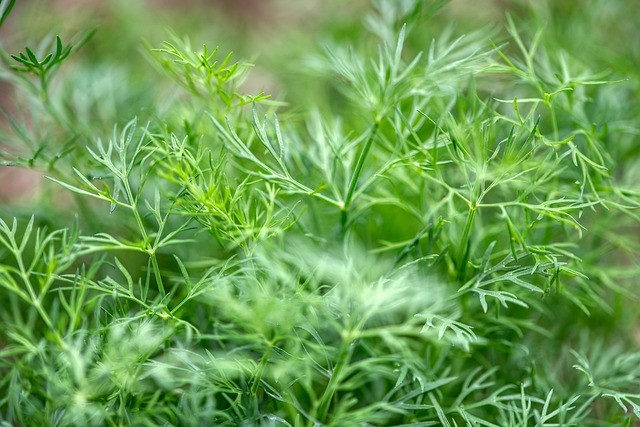
Dill
Anethum graveolens
A slender annual umbellifer of the carrot family, grown for its thread-fine, blue-green foliage and flat yellow umbels. Stems are single, hollow and finely ridged, reaching around 40–120cm, and the whole plant carries a bloom that makes it look greyer than fennel. Leaves are cut into hair-like segments and used fresh with fish, potatoes and cucumber; the flat winged seeds are used in pickling and bread. Native to the eastern Mediterranean and western Asia, it is long cultivated and turns up in Britain as a garden escape.
Not native to Britain or Ireland; a warmth-loving annual of gardens and allotments that persists as a casual on waste ground, tips, arable margins and pavement cracks, chiefly in southern and eastern England. Needs full sun and free-draining soil, and self-seeds where summers are warm.
No known eating toxicity in normal culinary amounts, raw or cooked, though the flavour is strong enough that most people use it sparingly. Take more care with feathery umbellifer foliage found growing wild: hemlock (Conium maculatum) is deadly and has purple-blotched stems and broader, fern-like leaflets rather than dill's unspotted stems and hair-fine segments. Handling large quantities of foliage in strong sun can irritate skin, and anyone who reacts to celery or carrot may react to dill.
Always use more than one reference to confirm a plant. You are responsible for what you choose to forage.
Habit and stem
A single hollow, finely ridged, hairless stem 40–120cm tall, blue-green with a waxy bloom and branching only near the top. Nothing woody at the base, which separates it at a glance from the persistent perennial crowns of fennel.
Flowers
Flat-topped compound umbels of small yellow flowers, typically with 20–40 rays and no bracts or bracteoles beneath. Yellow flowers rule out the white-flowered wild umbellifers of hedgerows and verges.
Leaves
Cut three or four times into thread-like, almost hair-fine segments, blue-green and soft, with a broad sheathing base clasping the stem. Any broader, flat-lobed or fern-like leaflet is not dill.
Seeds
Ripe mericarps are flat, oval and brown with pale wings along the edges, dropping easily from the head. Fennel's seeds are plumper, ridged and unwinged, so the seed shape settles the two even after the plants have died back.
Smell when crushed
Crushed foliage gives a clean, sharp scent close to caraway with a hint of aniseed behind it. A flat or unpleasantly mousy smell means you have something else, and mousiness in particular is a reason to stop handling the plant.
Updated 2026-08-08T07:14:26.606Z · Part of the shared Foragers Log catalogue · Herb