Chestnut
Castanea sativa
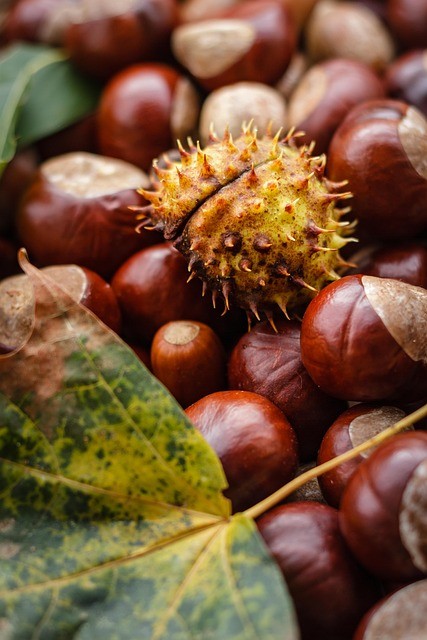
A large deciduous tree with long, glossy, saw-toothed leaves and bark that spirals into deep ridges on old trunks. In autumn it drops bristly green burrs, each splitting to release one to three brown nuts, flattened where they press together and tipped with a fine tassel. Roasted or boiled and peeled, the nuts are sweet and floury; raw they are dry and astringent.
Prefers light, acidic, free-draining soils and does poorly on lime or waterlogged ground. Planted in parks, estates and old coppice woodland and naturalised widely across southern and south-eastern England; scarcer northwards, where cool summers leave many nuts small or unfilled.
The burrs are sharply spiny; pick with gloves or roll them open underfoot. Nuts want cooking — raw they are astringent and poorly digested, and the papery inner skin peels most easily while warm. Score the shell before roasting whole nuts, as they burst. Tree nut allergies apply, and windfalls beside busy roads carry traffic pollution.
Always use more than one reference to confirm a plant. You are responsible for what you choose to forage.
Leaves
Oblong and glossy, 10–25 cm long, with regular saw-like teeth each drawn out to a fine bristle tip, borne singly on short stalks along the twig. A simple toothed leaf, not a compound one — visible from several metres away.
Burr
A green case thickly clothed in slender, flexible spines, splitting into two to four valves in autumn to release its nuts. The spines are numerous and hair-fine rather than few and stout.
Nut
Rich brown and shiny, with a pale scar at the base and a pointed tip carrying a wispy tassel. Where two or three share a burr each nut is flattened on one or both sides; single nuts are more rounded but still keep the tassel.
Catkins
Long, upright, cream-yellow catkins appear in July, strongly and sweetly scented, with the male flowers along the length and the small female flowers clustered at the base. Useful for confirming the tree months before the nuts are ready.
Bark
Grey-brown, smooth when young, developing deep fissures that twist in a spiral around mature trunks. Distinctive on veteran coppice stools.
Updated 2026-08-08T06:53:06.644Z · Part of the shared Foragers Log catalogue · Fruit