Common horse-chestnut
Aesculus hippocastanum
This species is poisonous and can cause serious illness. Listed here so you can recognise and avoid it.
A large spreading tree with grey-brown flaking bark, fat sticky winter buds and palmately compound leaves of five to seven leaflets radiating from a single long stalk. Upright candles of white flowers, each blotched yellow then pink, appear in May, followed by thick green cases with short stout spines holding one or two glossy brown conkers. Naturalised from the Balkans and planted widely; the conkers are gathered for saponin-rich soap and laundry liquid rather than for the kitchen.
Planted rather than truly wild: parkland, village greens, avenues, churchyards, school grounds and roadsides throughout Britain and Ireland, occasionally self-seeding onto woodland edges and hedge banks on deep, moist soils.
Toxic if eaten. Conkers, leaves and bark contain aesculin and saponins, and a chewed conker brings vomiting, diarrhoea and stomach pain; children and dogs are the usual casualties. Roasting does not make them safe. Ripe conkers fall hard from height in wind.
Always use more than one reference to confirm a plant. You are responsible for what you choose to forage.
Leaf
Palmately compound, with five to seven stalkless leaflets spreading like fingers from the end of one long petiole, each leaflet broadest above the middle and irregularly toothed. Nothing else planted at this size in UK parks carries that arrangement.
Flowers
Upright conical panicles 20–30cm tall, held clear of the foliage in May. Individual flowers are white with a yellow blotch at the throat that turns pink once pollinated, so a single candle often shows both colours.
Fruit case
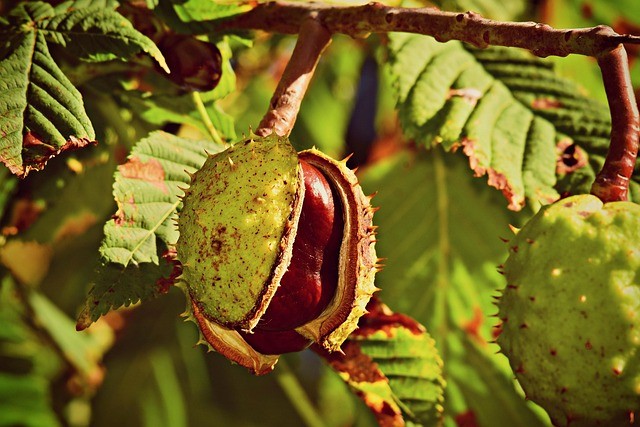
A thick, leathery, pale green sphere with short, stout, widely spaced spines that splits into two or three parts. Inside is usually a single glossy red-brown conker with a matt pale scar where it sat against the case.
Winter buds
Large, opposite, glossy red-brown and noticeably sticky to the touch, set above horseshoe-shaped leaf scars marked with small dots. Useful for naming the tree from bare twigs alone.
Leaf-miner blotching
From midsummer the leaves usually brown and curl from the mines of the horse-chestnut leaf-miner moth, so trees can look autumnal by August. It disfigures the tree without changing the identifying features.
Updated 2026-08-07T20:52:36.079Z · Part of the shared Foragers Log catalogue · Fruit