Calabrese
Brassica oleracea
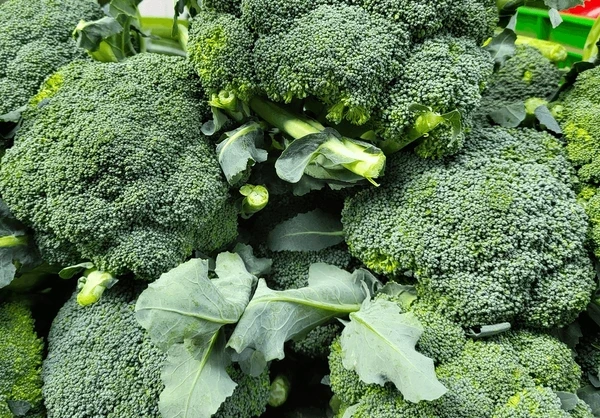
A cultivated cabbage grown for its flower buds rather than its leaves. A single dense dome of tight blue-green buds, 10–20cm across, sits on one thick pale stalk above a ring of broad waxy leaves. Cut while the buds are still closed; smaller side shoots follow for several weeks. This is the broccoli of the greengrocer, as opposed to the purple sprouting kind that stands the winter.
Not a wild plant in Britain and Ireland. Grown in gardens, allotments and field crops on deep, firm, limed soil in an open sunny site. It may persist briefly on tips and allotment edges but does not naturalise.
No toxicity in normal eating, raw or cooked. Brassicas contain goitrogenic compounds, so anyone managing a thyroid condition may prefer to moderate large raw quantities. Heads hold aphids and cabbage white caterpillars deep among the buds — a soak in salted water before cooking shifts them.
Always use more than one reference to confirm a plant. You are responsible for what you choose to forage.
Head
One terminal dome of tightly packed blue-green flower buds on a single thick stalk, reading as a mass of distinct beads from arm's length. Cauliflower's curd, by contrast, is white and smooth-surfaced with no visible individual buds.
Side shoots
After the main head is cut, a succession of smaller loose green heads rises from the leaf axils. Purple sprouting broccoli reverses this pattern entirely, giving many small violet shoots and never one large green dome.
Leaves and stem
Broad grey-green leaves with a waxy bloom, wavy edges and thick pale midribs, clasping a stout upright stem. No solid heart forms at the centre, which separates it from a heading cabbage at a glance.
Bolting
Left uncut, the buds open into four-petalled yellow flowers on lengthening stalks and the head goes stringy. That is the end of the crop, though the flowers themselves are still edible.
Updated 2026-08-07T20:52:32.584Z · Part of the shared Foragers Log catalogue · Vegetable