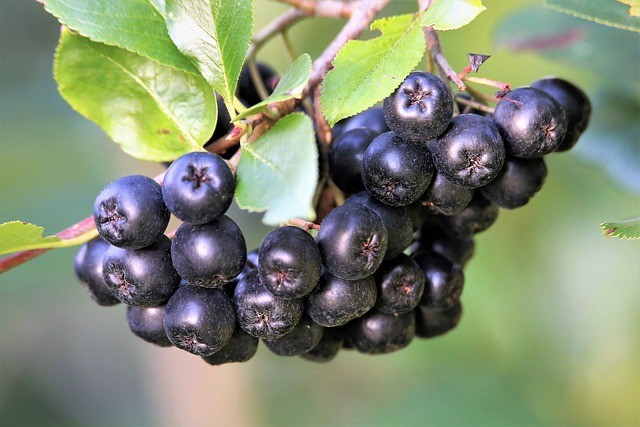
Black chokeberry
Aronia melanocarpa
A suckering deciduous shrub to around 2 m, with glossy, finely toothed oval leaves that turn deep crimson in autumn, flat-topped clusters of small white flowers in late spring, and pea-sized purple-black fruit by late summer. Each fruit is a small pome and keeps a five-toothed calyx crown at its tip. Raw it is juicy but mouth-puckeringly astringent, so it is mostly cooked into jams, syrups, cordials and juice, often blended with sweeter fruit.
Native to eastern North America and in Britain and Ireland a planted shrub of gardens, parks, car parks and amenity hedging, also grown as a fruit crop. It prefers damp, acid to neutral soil in sun, and bird-sown plants turn up in scrub and on heathy ground near plantings.
Not known to be toxic, but the tannin-rich skins are extremely astringent raw and a large quantity leaves the mouth dry and can unsettle the stomach; cooking with sugar tames it. As with other members of the rose family the seeds hold traces of cyanogenic compounds, so there is no reason to crush and eat them in bulk. Most UK plants are amenity or roadside shrubs, so consider spraying and traffic grime.
Always use more than one reference to confirm a plant. You are responsible for what you choose to forage.
Habit
An upright, thicket-forming shrub usually 1–2 m tall, spreading by suckers into dense clumps. Stems are entirely thornless, which separates it at a glance from the spiny black-fruited shrubs of hedge and scrub.
Leaves
Alternate, simple, obovate with a short point, 3–7 cm long and evenly toothed all round the margin, glossy dark green above and paler beneath. Not lobed and not aromatic when crushed, unlike blackcurrant foliage.
Fruit
Purple-black, 6–10 mm across, held in flat-topped clusters of around ten on red stalks. Cut one open and it is a miniature pome with several small soft seeds in a core, not a single stone, and the withered calyx persists as a small crown at the tip.
Midrib glands
Run a fingertip and a hand lens along the upper side of the midrib: Aronia carries a line of tiny dark glandular hairs there. This is the closest thing to a decisive check on a leafy shoot with no fruit.
Updated 2026-08-07T20:57:45.186Z · Part of the shared Foragers Log catalogue · Fruit