Buckthorn
Rhamnus cathartica
This species is poisonous and can cause serious illness. Listed here so you can recognise and avoid it.
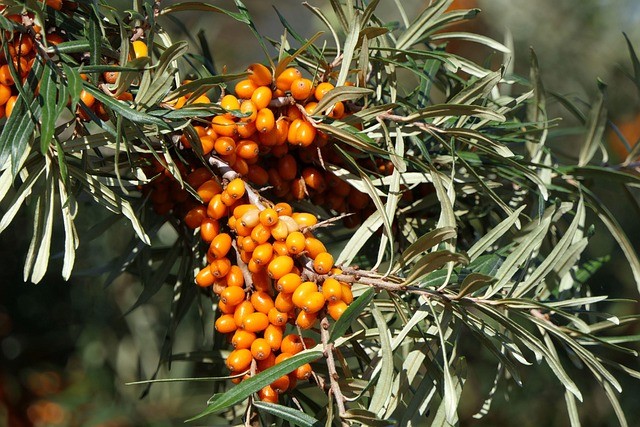
A thorny deciduous shrub or small tree of chalk scrub, reaching about 6 m, with sub-opposite oval leaves whose few veins curve forward towards the tip and short side twigs ending in a stiff spine. Small greenish flowers on female bushes give clusters of black berries in autumn. The fruit is a drastic purgative rather than a food; bark and unripe berries were formerly used medicinally and as a source of green and yellow dye.
Dry calcareous ground — chalk and limestone scrub, hedgerows, woodland edges and fen carr. Native through central and southern England with scattered records in Wales, rare and largely planted further north. The main foodplant of brimstone butterfly larvae.
The berries are a violent purgative: a small handful brings griping, vomiting and prolonged diarrhoea, with a real risk of dehydration in children, and the bark acts more strongly still. Alder buckthorn (Frangula alnus) is likewise purgative, but is thornless with untoothed leaves. Twigs end in stiff spines, so handle and cut with care.
Always use more than one reference to confirm a plant. You are responsible for what you choose to forage.
Habit and thorns
A crooked, open shrub or small tree to about 6 m, the branches often set at near right angles and most short side twigs hardened into a sharp terminal spine. The other native Rhamnus relative, alder buckthorn, is never thorny.
Leaves
Oval, finely toothed and 3–6 cm long, on a clear stalk and borne in near-opposite pairs. Two to four pairs of veins curve strongly forward and converge towards the leaf tip — the toothed margin plus the curving veins is the combination to check.
Flowers
Tiny four-petalled yellow-green flowers in dense little bunches at the leaf bases in May and June. Male and female flowers sit on separate bushes, so many shrubs never carry fruit at all.
Berries
Glossy black, 6–8 mm, ripening from green through red in tight clusters along the twigs. Crushed fruit stains the fingers a greenish yellow and each berry holds three or four hard seeds, not a single stone.
Updated 2026-08-08T12:19:55.436Z · Part of the shared Foragers Log catalogue · Fruit