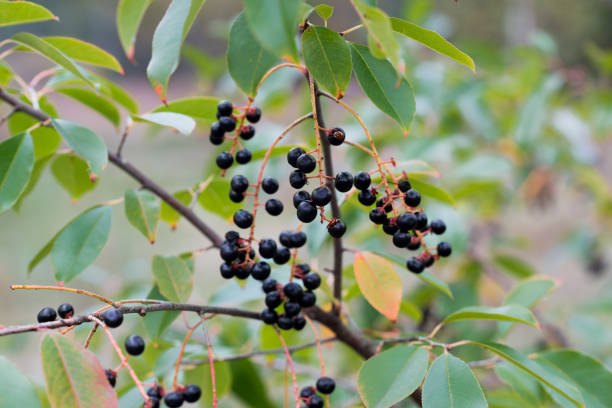
Black cherries
Prunus serotina
A deciduous tree with glossy, finely toothed leaves and dark, scaly bark that smells of bitter almond when scratched. Small white flowers hang in long racemes in late spring, followed by pendulous strings of pea-sized cherries ripening through red to near-black. The ripe flesh is bittersweet and slightly astringent, used mostly for jellies, cordials and flavouring spirits.
A North American tree, planted here from the 18th century and naturalised on light sandy and acidic soils: heathland margins, birch and pine woodland, plantation edges, railway banks and disturbed ground. Scattered and local, mainly in southern and eastern England.
Only the fully ripe flesh is eaten. Leaves, twigs, bark and the stones contain cyanogenic glycosides, so do not crush or chew the stones, and keep wilted foliage away from livestock. Unripe red fruit is harshly astringent. Cherry laurel (Prunus laurocerasus) also carries black fruit in racemes but is an evergreen shrub with thick, leathery, near-untoothed leaves, quite unlike this tree's thin deciduous ones. Trees near roads and railway lines pick up traffic dirt.
Always use more than one reference to confirm a plant. You are responsible for what you choose to forage.
Bark
Young bark is smooth, dark reddish-brown with pale horizontal lenticels; mature bark turns near-black and breaks into small curling scaly plates. A scratched twig or slice of bark gives a strong bitter-almond smell.
Flowers and fruit in racemes
Both flowers and fruit hang in long, narrow, drooping racemes of twenty or more, all on one stalk. Wild cherry and the orchard cherries carry their fruit in small umbel-like bunches of two to five on long individual stalks.
Leaf underside
Leaves are narrow-oval, leathery and glossy above with fine incurved blunt teeth. Turn one over: a line of rusty orange-brown hairs runs along either side of the midrib. Absence of those hairs on a raceme-fruited tree points to bird cherry instead.
Ripe fruit
Drupes 8-10mm across, ripening green to red to purple-black, with a small persistent green calyx cup where the fruit meets the stalk. Flesh is dark, bittersweet and astringent until fully black.
Updated 2026-08-07T20:37:39.818Z · Part of the shared Foragers Log catalogue · Fruit