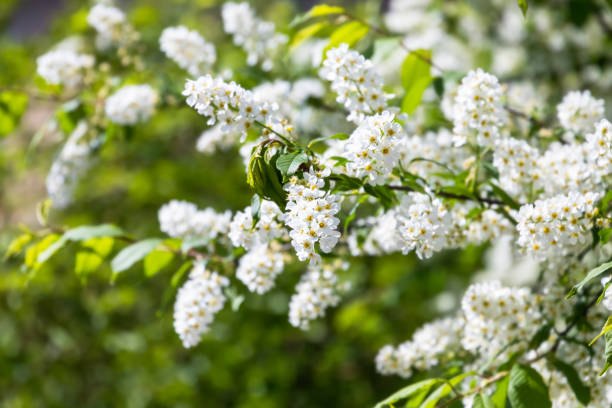
Bird cherry
Prunus padus
Eating this will make you ill. Listed here so you can recognise and avoid it.
A small deciduous tree or suckering shrub, reaching around 15m, with thin matt leaves and long upright racemes of fragrant white flowers in May. The fruit is a pea-sized glossy black cherry with a single stone nearly filling it, mouth-dryingly bitter raw. Cooked and sweetened it gives a dark jelly or syrup, and in northern Europe it is used to flavour spirits.
Native to damp woodland on limestone and to upland streamsides and gill woods in northern England, Scotland, Wales and Ireland, often alongside ash and hazel. Widely planted as a street and amenity tree further south, where it also turns up self-sown in hedges.
Edible cooked but harshly astringent raw, and raw fruit in quantity can upset the stomach. The stones, leaves and bark hold cyanogenic glycosides, so cook the fruit whole and strain rather than crushing the stones. Cherry laurel (Prunus laurocerasus), which is poisonous, also carries erect racemes and small black fruits, but it is evergreen with thick leathery leaves.
Always use more than one reference to confirm a plant. You are responsible for what you choose to forage.
Flower and fruit arrangement
Flowers in a raceme of 10–40 on a single stalk, held upright or spreading, ripening into a spike of small black cherries. This spike is the feature visible from a distance and the one that separates it from the cluster-fruiting cherries.
Leaves
Elliptic, 6–10cm, thin and matt with fine even teeth, on a short stalk usually bearing a pair of small glands near the blade. Nothing about the leaf is leathery or evergreen.
Bark
Smooth grey-brown with horizontal lenticels, and strongly sour-smelling when scraped — an unpleasant almond note rather than a sweet one.
Fruit and taste test
6–8mm, glossy black when ripe, with thin flesh over a single large stone. A bite is intensely astringent and dries the mouth; that reaction confirms bird cherry rather than a sweet cherry, and is why the crop is cooked rather than eaten raw.
Updated 2026-08-07T21:15:20.165Z · Part of the shared Foragers Log catalogue · Fruit