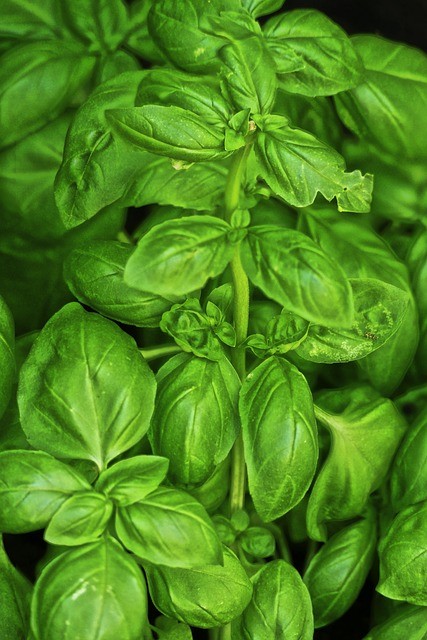
Basil
Ocimum basilicum
A tender annual of the mint family, reaching about 50 cm, with soft square stems and glossy, broadly oval leaves carried in opposite pairs. Crushed foliage gives a sweet clove-and-anise scent that settles the identification more surely than leaf shape does. Grown for the leaf, which is used raw or stirred in at the very end of cooking, as heat drives off the aroma.
Native to tropical Africa and Asia and not naturalised in Britain or Ireland, where it persists only where it is grown: pots, windowsills, greenhouses and warm sheltered beds on free-draining soil in full sun. Frost kills it outright, so any outdoor plant is garden stock or a short-lived self-sown seedling beside cultivation.
No significant toxicity in culinary use; the leaves are eaten raw and need no preparation. Concentrated basil essential oil is a different matter and is not for internal use. Contact dermatitis is uncommon but reported in people handling large quantities. Supermarket pot plants may have been treated with products not intended for repeat harvesting, so check the label before picking heavily from one.
Always use more than one reference to confirm a plant. You are responsible for what you choose to forage.
Habit and hardiness
An upright, soft-stemmed annual to roughly 50 cm, blackening and collapsing at the first frost. Nothing persisting outdoors through a British winter is basil, which rules out the perennial mints, marjorams and sages it otherwise resembles in leaf.
Leaves
Broadly oval, 3–8 cm, smooth and glossy, often cupped or slightly puckered, with untoothed or only faintly toothed margins and a clear leaf stalk. Mint leaves by contrast are dull, wrinkled, sharply toothed and near-stalkless.
Smell when crushed
Sweet and warm, clove and aniseed over a green base. Purple and lemon-scented cultivars shift the balance but keep the clove note. A crushed leaf smelling purely of mint, lemon or resinous pine is not sweet basil.
Stem
Square in cross-section, as in all the mint family, green or flushed purple, sappy and easily snapped near the tip and only slightly firmer at the base. A round stem rules the plant out immediately.
Flowers
Small two-lipped white to pale pink flowers set in widely spaced whorls up an erect terminal spike, each whorl backed by a leafy bract. This open, tiered spike is unlike the dense rounded flower heads of mint and marjoram.
Updated 2026-08-07T20:46:06.996Z · Part of the shared Foragers Log catalogue · Herb