Asparagus
Asparagus officinalis
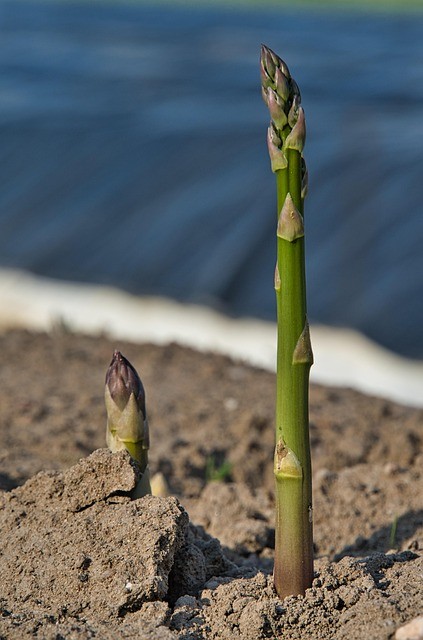
A tall perennial grown for the thick green spears that push up from an underground crown each spring. Spears are smooth, tightly scaled and often flushed purple at the tip, and are cut at or just below ground level while still firm. Left uncut, each spear opens into a feathery, many-branched stem to about 1.5 m with needle-like cladodes in place of true leaves. Cooked, the flavour is sweet and grassy.
Cultivated on light, free-draining sandy soils and well established as a garden escape in parts of southern and eastern Britain, where it turns up on railway embankments, waste ground, sandy heath and coastal dunes. A separate low-growing native form occurs on sea cliffs in south-west England and Wales.
Spears are eaten cooked; large quantities raw sit badly with some people. The red berries carried on female plants contain saponins and cause vomiting and diarrhoea, so they are not food. Repeated handling of cut stems causes a rash in some pickers. Wild coastal asparagus (Asparagus prostratus) is legally protected and should not be cut.
Always use more than one reference to confirm a plant. You are responsible for what you choose to forage.
Spear
Emerges singly straight from bare soil, thumb-thick to pencil-thin, with overlapping triangular scales pressed tight to a blunt, often purple-tinged tip. Nothing else in an asparagus bed comes up as an unbranched scaly shoot with no rosette of leaves at its base.
Summer stem and cladodes
An uncut spear branches into an airy plume of soft green needles up to 1.5 m tall. These are cladodes, not leaves, and they are limp and flexible — quite unlike the stiff, flattened fronds of a true fern growing in the same soil.
Flowers
Small greenish-white bells, about 5 mm, hanging singly or in pairs from the joints of the branches in early summer. Plants are male or female, so only some individuals go on to set fruit.
Berries
Round red berries 6–10 mm across, ripening on female plants from late summer. Their presence confirms the plant but marks the end of the eating season, and the berries themselves are not edible.
Updated 2026-08-08T12:02:59.305Z · Part of the shared Foragers Log catalogue · Vegetable