Amethyst Deceiver
Laccaria amethystina
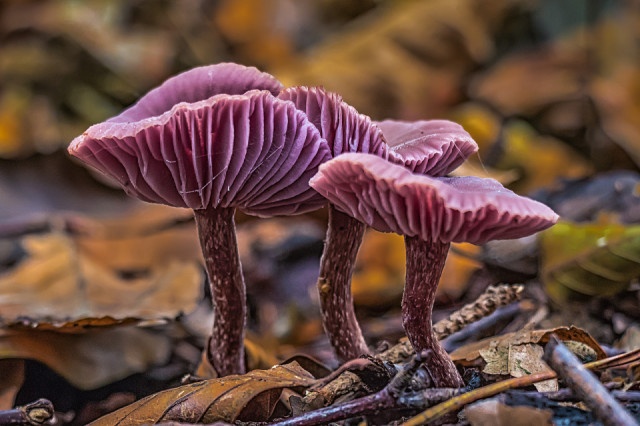
A small woodland mushroom, deep lilac-violet throughout when fresh: cap, widely spaced gills and tough twisted stem all much the same colour. In dry weather it fades to blotchy buff and becomes far harder to name, which is where the "deceiver" part comes from. Thin-fleshed and mild, it is picked mostly for the colour, which survives light cooking better than the flavour does.
Mycorrhizal, associating chiefly with beech and oak and also with birch and conifers, so it fruits from soil, leaf litter and mossy banks rather than from wood. Common and widespread in damp broadleaved woodland across Britain and Ireland.
Edible cooked but slight, and Laccaria species are known to take up arsenic from the soil, so treat it as an occasional addition rather than a bulk crop and avoid ground likely to be contaminated. Two purple lookalikes matter in the same woodland: Lilac Fibrecap (Inocybe geophylla var. lilacina) has a silky, sharply umbonate cap and gills that mature dull clay-brown instead of staying violet, and Lilac Bonnet (Mycena pura) has a thin brittle stem, pale non-violet gills and a radish smell when crushed.
Always use more than one reference to confirm a plant. You are responsible for what you choose to forage.
Cap
1–6 cm, deep lilac-violet and slightly translucent when moist, drying to patchy buff-ochre from the centre outwards. The surface is minutely scurfy or roughened, not silky-fibrillose as in the lilac Inocybe species.
Gills
Thick, broad and widely spaced, attached to the stem, and holding their violet colour long after the cap has faded. Often dusted white by their own spores. Gills that mature dull brown mean an Inocybe, not this.
Stem
Tough and fibrous, twisted lengthwise into visible strands, the same violet as the cap, with a whitish woolly mat of mycelium and litter at the base. It tears in strings rather than snapping cleanly like a brittle-stemmed bonnet.
Spore print and spores
Spore print white. Under a lens or microscope the spores are almost spherical and covered in coarse spines, which separates Laccaria from similarly coloured pink- or brown-spored genera.
Smell
Faint and unremarkable, at most slightly mushroomy. A clear smell of radish or of freshly dug earth points away from this species and towards Mycena pura or an Inocybe.
Updated 2026-08-08T11:13:29.627Z · Part of the shared Foragers Log catalogue · Fungus