Wild service tree
Torminalis glaberrima
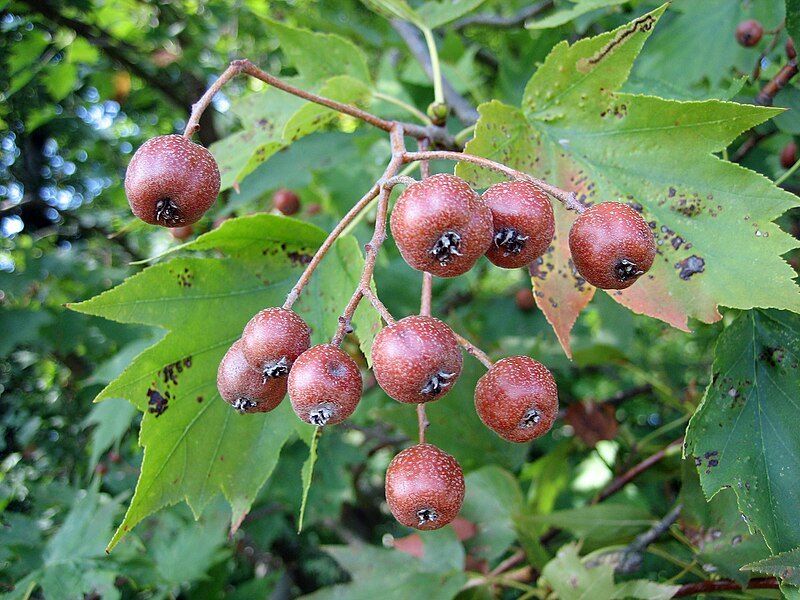
A medium to large deciduous tree of old woodland, with maple-like leaves cut into five to nine sharply pointed lobes that colour coppery red in autumn. Flat clusters of white flowers in late spring give way to small russet-brown fruits, known as chequers, speckled with pale dots. They are hard and mouth-puckering until bletted, when the flesh softens to a sweet date-like pulp; traditionally they were steeped in beer or spirits.
Heavy clay, chalk and limestone soils in oak and ash woodland, often as scattered single trees suckering from the roots. Largely southern and central England — the Weald, Chilterns, Wye Valley and Essex — where it is treated as an ancient woodland indicator; scarce in Wales and Ireland.
The bletted fruit is eaten in small quantities and is astringent enough before bletting to upset the stomach; hard, unripe chequers are not worth eating. As with other pome fruit in the rose family the pips hold cyanogenic compounds, so avoid crushing or chewing them in quantity. The tree is uncommon and slow to regenerate, so take a small share of one tree's crop and get the landowner's permission before picking.
Always use more than one reference to confirm a plant. You are responsible for what you choose to forage.
Leaves
Broad and maple-like, with five to nine triangular, forward-pointing lobes, glossy green and hairless on both sides. This rules out the other native whitebeams and rowans at a glance: rowan leaves are pinnate with separate leaflets, and whitebeam leaves are unlobed or shallowly lobed with a white felted underside.
Bark
Smooth and grey on young trunks, breaking on older trees into small oblong plates that flake away to leave darker patches — the chequered pattern that gives the fruit its name.
Flowers
White, five-petalled and around 10–15 mm across, carried in loose flat-topped clusters in May and June. Worth noting the tree in flower, as the fruit is easy to overlook later in the year.
Fruit
Oval berries about 10–15 mm long, brown to russet and densely freckled with pale lenticels, hanging in open bunches on long stalks. They stay green-brown and rock hard well into autumn; the pale speckling is the most reliable confirmation, as no other British tree carries spotted brown pomes of this shape.
Ripeness test
Only worth picking when the flesh has turned soft and dark right through, usually after the first frosts or a week or two of storage. A firm fruit is intensely astringent and will not sweeten on the tree in a cold year.
Updated 2026-08-07T20:46:17.596Z · Part of the shared Foragers Log catalogue · Fruit