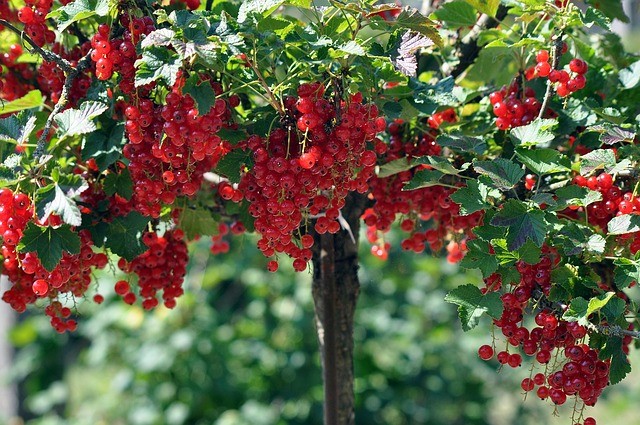
White currant
Ribes rubrum
A spineless currant bush to about 1.5 m, upright then arching, hung with slender strings of translucent creamy-white to pale amber berries. It is not a species in its own right but an albino cultivar group of the same plant as redcurrant, so it turns up where people have planted it — old gardens, allotments and hedges near houses — rather than in genuinely wild ground. The fruit is milder and sweeter than red forms, good raw, and it sets well in jellies and country wines.
A garden plant that persists and spreads from cultivation, found on allotments, in old orchards, and on hedge banks, railway sides and damp woodland edges close to habitation. Prefers moist, loamy soil in full sun to part shade across lowland Britain and Ireland.
The ripe fruit is eaten raw or cooked with no special preparation and there is no established toxicity in the berries, though the leaves and stems are not a food. Snowberry (Symphoricarpos albus) is a common naturalised hedge shrub with white berries and can cause vomiting and stomach pain if eaten: white currants hang in slender drooping racemes and are translucent with the seeds visible through the skin, while snowberry's are opaque, spongy and packed tight against the stem. As with any fruit picked on allotments or roadsides, consider spray drift and traffic dust before eating unwashed.
Always use more than one reference to confirm a plant. You are responsible for what you choose to forage.
Fruit
Translucent creamy-white to pale amber berries about 8 mm across, in drooping racemes of eight to twenty, each berry keeping a small dried flower remnant at its tip. The skin is thin enough to see the seeds through, which no other pale-berried hedgerow shrub matches.
Stems
Completely unarmed — no spines on the stems and none at the leaf nodes. That single check separates it from gooseberry (Ribes uva-crispa), which carries spines at every node and bears its fruit singly or in twos rather than in strings.
Leaves
Palmately three- to five-lobed, bluntly toothed, up to about 8 cm across and slightly downy beneath. Crushed, they smell faintly green rather than pungent; a strong resinous cat-like smell means blackcurrant instead.
Flowers
Small, saucer-shaped and greenish-yellow, hanging in loose racemes in April and May. Inconspicuous from a distance, so the plant is far easier to spot once the fruit strings have formed.
Updated 2026-08-08T07:14:20.548Z · Part of the shared Foragers Log catalogue · Fruit