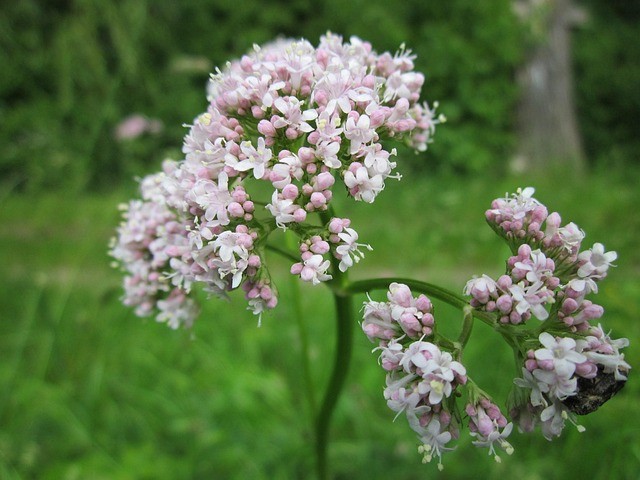
Valerian
Valeriana officinalis
A tall perennial of damp ground, reaching about 1.5 m, with opposite pinnate leaves of narrow toothed leaflets and a domed, branched head of tiny pale pink to white tubular flowers through summer. It is grown and gathered for the root rather than the leaf: short, pale and fibrous, faintly scented when fresh and developing a strong musky smell as it dries. Traditionally the dried root is used as a bedtime tea.
Damp grassland, ditches, streambanks, fen carr and wet woodland edges, with a slenderer form on dry chalk and limestone grassland. Widespread through Britain and Ireland, thinning in the far north.
The dried root is sedative and can leave people drowsy or headachy; it is not suitable before driving and sits badly with alcohol or sedative medication, and anyone pregnant, breastfeeding or on prescribed medicines should take advice before using it. Hemlock water-dropwort (Oenanthe crocata) occupies the same wet ditches and streambanks and has deadly roots; its leaves are alternate and parsley-like on a hollow grooved stem, while valerian's are opposite and pinnate. Digging up any wild plant needs the landowner's permission.
Always use more than one reference to confirm a plant. You are responsible for what you choose to forage.
Leaves
Pinnate, with five to eleven pairs of narrow toothed leaflets, set in opposite pairs up a stout furrowed stem. The strictly opposite arrangement separates it from the alternate-leaved umbellifers that share its ditches.
Flowerhead
A dense, rounded and repeatedly branched corymb of very small five-lobed tubular flowers, pale pink fading to near white, with a small swelling at the base of each tube. It is not a flat spoked umbel, though it reads as one from a distance.
Root and rhizome
A short pale rhizome with a mat of fibrous roots, almost odourless when first dug. The characteristic heavy musky smell only develops during drying, so a fresh root that smells of celery or parsley is not this plant.
Seed
Each small dry fruit carries a feathery parachute of hairs and drifts on the wind, unlike the paired ribbed seeds of the carrot family.
Updated 2026-08-07T21:15:29.313Z · Part of the shared Foragers Log catalogue · Herb