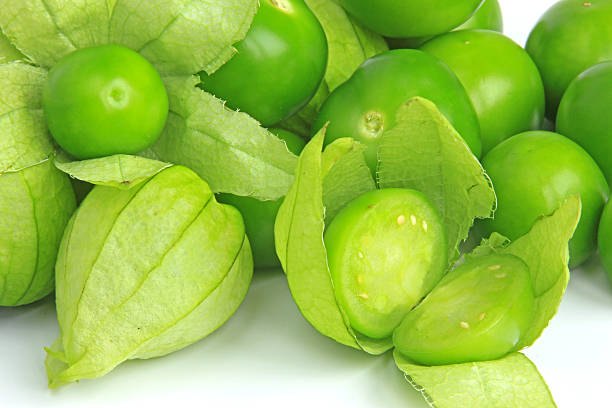
Tomatillo
Physalis philadelphica ixocarpa
A sprawling, frost-tender annual of the nightshade family, grown for round fruit each held inside a papery, five-angled husk that is split open as the fruit swells. The flesh is firm and sharply acidic with a faint citrus note, and is the basis of Mexican salsa verde; it is usually cooked, though fully ripe fruit can be eaten raw. In Britain it is an allotment and glasshouse crop rather than a wild find.
Not naturalised in Britain and Ireland. Grown in gardens, allotments and polytunnels, and occasionally persisting for a season as a self-sown casual on warm, disturbed ground near where it was cultivated. Wants a sheltered sunny site and free-draining soil; the first frost kills it.
The ripe fruit is a normal food, cooked or raw. Hard green immature fruit, the husk and the leaves contain solanine-type alkaloids and can cause stomach upset, so pick only fruit that has filled and split its husk. Chinese lantern (Alkekengi officinarum), a frequent garden escape, carries a similar papery husk but ripens bright orange-red around one small loose berry, where a tomatillo husk stays green to straw-brown and is stretched tight by the fruit inside it.
Always use more than one reference to confirm a plant. You are responsible for what you choose to forage.
Husk (inflated calyx)
Each fruit sits inside a papery, five-angled bladder that starts green and dries to straw-brown, splitting as the fruit swells. No tomato or pepper has this; the husk is the first thing to look for from a couple of metres away.
Fruit
Round and 2–4cm across, green ripening to yellow-green or dull purple, with a slightly sticky skin under the husk. Much larger than the single cherry-sized orange berry of Cape gooseberry or Chinese lantern.
Flowers
Yellow and five-lobed, about 1–2cm across, with dark purple-brown blotches in the throat and often bluish anthers. Cape gooseberry (Physalis peruviana) has a nodding bell-shaped flower on a densely hairy calyx.
Stems and leaves
Branched, sprawling stems to about a metre, with thin ovate leaves that are usually coarsely and irregularly toothed and only sparsely hairy. If the whole plant feels velvety to the hand it is more likely Cape gooseberry.
Updated 2026-08-08T11:01:28.891Z · Part of the shared Foragers Log catalogue · Vegetable