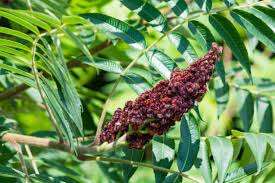
Staghorn sumac
Rhus typhina
A suckering small tree with sparse, antler-like branching, the young shoots and leaf stalks thickly furred with rust-red hairs. The long pinnate leaves are so finely divided in this cut-leaf cultivar that the foliage reads as fern-like, turning scarlet in autumn above dense upright cones of crimson, sticky-haired fruit. The fruit heads are steeped in cold water for a sharp lemony drink, or dried and ground as a souring spice.
Not native. Planted in gardens, parks and car parks across Britain and Ireland and spreading from them by root suckers onto railway embankments, roadside verges and waste ground. Prefers full sun and free-draining, even poor soil; not a woodland plant.
Ripe fruit heads are sour rather than harmful, but this is a cashew-family plant: the sap and fruit hairs can raise a rash on sensitive skin, and anyone reacting to mango or cashew may react here. Most accessible stands are roadside or railway suckers, so pass over sprayed or traffic-dusted plants and any head gone black with mould.
Always use more than one reference to confirm a plant. You are responsible for what you choose to forage.
Habit and branching
A thicket of upright stems from spreading roots, each with few, thick, forking branches held stiffly out like antlers. Broken shoots bleed a milky sap.
Fruit cone
A dense, upright, conical head of small crimson drupes at the shoot tip, each fruit coated in sticky acid hairs. Upright and packed solid is the point of the observation: rowan and whitebeam carry loose, drooping clusters of smooth round berries instead.
Velvety shoots
Young twigs and leaf stalks are covered in dense rust-red hairs that are obvious to the fingertips. Smooth sumac, Rhus glabra, is the same plant in outline but has bare, waxy, grey-bloomed twigs.
Leaves
Pinnate, up to 60cm long, with many toothed leaflets in opposite pairs and a single leaflet at the tip. In the 'Dissecta' clone the leaflets are cut almost to the midrib, giving a much finer outline than ordinary staghorn sumac.
Taste test
Touch a fingertip to a ripe fruit head and lick it: sharply sour and lemon-like. No sourness at all means the head has been rained out and is not worth picking, whatever its colour.
Updated 2026-08-07T20:46:13.320Z · Part of the shared Foragers Log catalogue · Fruit