Sea buckthorn
Hippophae rhamnoides
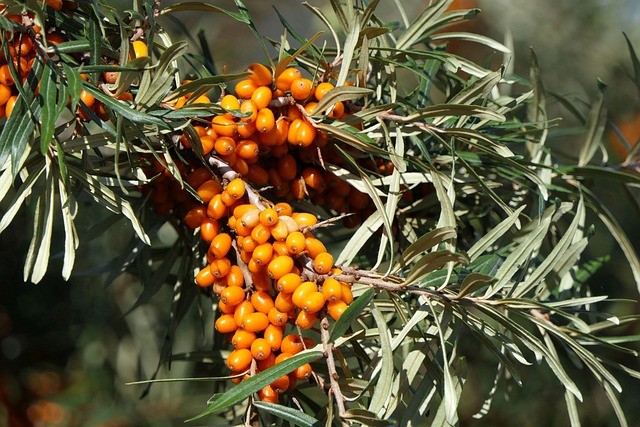
A spiny, silver-leaved shrub of the coast, suckering into dense thickets and reaching about four metres. Female bushes carry masses of soft orange berries pressed tight along the twigs from late summer onwards. The juice is sharply acidic, oily and very high in vitamin C, and is used for cordials, syrups, jellies and sauces rather than eaten by the handful.
A pioneer of open sand dunes, shingle and soft coastal cliffs, fixing nitrogen through root nodules and so thriving on bare, poor sand. Native to the east coast of England and widely planted elsewhere in Britain and Ireland for dune stabilisation, where it has naturalised.
The berries are safe raw but intensely sour, and a large quantity can loosen the bowels; the juice stains skin and cloth. Branches carry hard, sharp thorns, so pick with care. Many UK stands sit on dune SSSIs where the shrub is actively managed as a non-native, so check access and local restrictions first.
Always use more than one reference to confirm a plant. You are responsible for what you choose to forage.
Leaves
Narrow and strap-like, 3–6 cm long, dull grey-green above and conspicuously silver-scaly beneath, set alternately and almost without stalks. No other orange-berried UK shrub has this combination of linear leaves and silvered undersides.
Thorns
Side shoots harden into stiff woody spines with a sharp tip, scattered the whole length of the branch rather than confined to the base. This is why fruiting sprigs are usually cut rather than stripped by hand.
Berries
Soft, translucent orange and 6–8 mm across, each with a single hard seed, packed in dense clusters directly against two-year-old wood. They are not carried in stalked bunches held clear of the shoot, as rowan and firethorn fruits are.
Separate sexes
Male and female flowers grow on different bushes, so only some plants in a thicket ever fruit. A berry-free stand in autumn is normally male, not unripe — worth checking a few metres along before writing the site off.
Updated 2026-08-08T07:14:30.404Z · Part of the shared Foragers Log catalogue · Fruit