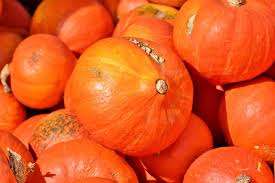
Pumpkin
Cucurbita
A sprawling annual vine with bristly hollow stems, broad palmately lobed leaves and large funnel-shaped yellow flowers, ripening one to a few heavy, hard-rinded fruits. Pumpkin is a kitchen name rather than a botanical one: round, ribbed, orange fruits are grown from three species — Cucurbita pepo, C. moschata and C. maxima — and the flesh, seeds and flowers are all used. The fruit stalk is the feature that tells the three apart.
Not a wild plant in Britain or Ireland. Grown in gardens, allotments and field crops on rich, moisture-retentive soil in full sun, and frost-tender at both ends of the season. Seedlings appear on compost heaps and where compost has been spread, but plants do not persist.
Flesh, seeds and flowers are eaten without special preparation. Any fruit tasting bitter should be spat out and discarded: bitterness signals cucurbitacins, which cause vomiting and diarrhoea, and it turns up occasionally in fruit grown from home-saved seed. Gourds sold for decoration are bred for appearance rather than eating. The bristly leaves and stems can irritate bare skin, and carved fruit left outdoors rots quickly.
Always use more than one reference to confirm a plant. You are responsible for what you choose to forage.
Habit and leaves
Long trailing stems run several metres across the ground from a single crown, rooting little as they go, with leaves up to 30cm across on stiff, hollow, bristle-covered stalks. Branched tendrils grip anything within reach.
Flowers
Large orange-yellow trumpets, male and female separately on the same plant. Male flowers sit on a long slim stalk and are the ones usually picked; female flowers have a small swollen ovary at the base that becomes the fruit, so picking them costs a pumpkin.
Fruit stalk
The most reliable guide to which species you have. Cucurbita pepo has a hard, five-angled ridged stalk; C. moschata a corky stalk that flares broadly where it joins the fruit; C. maxima a thick, round, soft-corky stalk with no ridges.
Rind at picking
A ripe fruit resists a pressed thumbnail and sounds hollow when tapped. A rind that dents easily means the fruit is immature — it can still be cooked and eaten straight away but will not keep in store.
Seed cavity
A single central cavity holding flat, cream, teardrop-shaped seeds in coarse fibrous strands, unlike the seeds set in firm flesh throughout a cucumber or courgette.
Updated 2026-08-07T20:41:54.871Z · Part of the shared Foragers Log catalogue · Vegetable