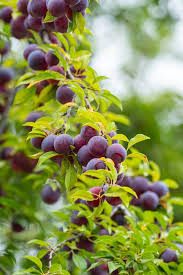
Opal plum
Prunus domestica
An early dessert plum, small to medium and roundish-oval, ripening from a yellow ground flushed red to a dull reddish-purple with a fine pale bloom. The flesh is deep golden, sweet and gage-scented, and parts readily from the stone when fully ripe. Raised at Alnarp in Sweden in the 1920s from Oullins Gage, it is self-fertile and among the first plums ready in a British garden, usually well ahead of Victoria.
A wholly cultivated tree in Britain and Ireland, grown in gardens, allotments and small orchards on a range of soils provided drainage is reasonable. Occasionally persists as a relic on old plot boundaries and in hedges near former gardens, but it does not naturalise from seed as itself.
The ripe flesh is eaten raw without preparation. The kernel inside the stone contains cyanogenic compounds, so stones should not be cracked and eaten or left to break up in preserves. Ripe and split fruit draws wasps and ferments fast on the tree. Garden and orchard trees and their windfalls belong to someone; ask before picking.
Always use more than one reference to confirm a plant. You are responsible for what you choose to forage.
Fruit
Small to medium, roundish-oval, around 30–40 mm, dull reddish-purple over yellow with a pale bloom. Shorter and rounder than the long, pinkish-red fruit of Victoria on the same site.
Season of ripening
The first of the common garden plums, usable in late July when most other cultivars are still hard and green. On a tree of unknown identity, cropping this early narrows the field considerably.
Flesh and stone
Deep golden-yellow, sweet and aromatic in the gage manner rather than sharp. The stone lifts almost clean from properly ripe fruit, which is a useful check against underripe fruit picked too soon.
Twigs and leaves
Compact tree, rarely much over 4 m, with dull green ovate leaves, finely toothed and softly downy beneath. Twigs are unarmed — no spines, which separates a domestic plum from blackthorn in a boundary hedge.
Blossom
White five-petalled flowers in late March and April, opening before or with the leaves. Being self-fertile it can set a heavy crop standing alone, so a solitary tree fruiting well is not unusual.
Updated 2026-08-08T11:13:25.501Z · Part of the shared Foragers Log catalogue · Fruit