Monkey puzzle
Araucaria araucana
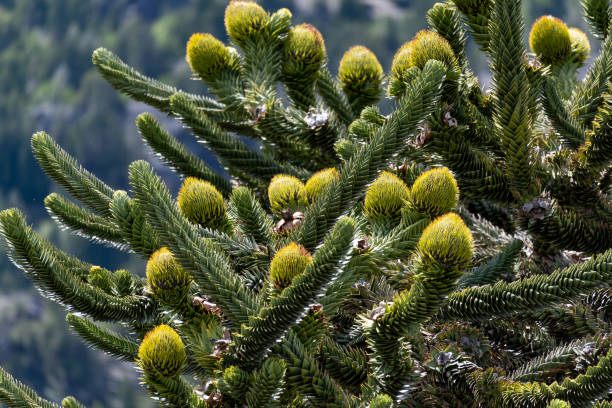
A tall evergreen conifer with whorls of stiff, upswept branches clothed in overlapping dark green triangular leaves that end in hard points. Female trees carry heavy near-globular cones high in the crown, which break apart on the tree to release long wedge-shaped seeds; these are roasted or boiled and eaten much like chestnuts. Native to Chile and Argentina, and planted across Britain since the 1840s.
Not naturalised in Britain. Planted as a specimen tree in parks, churchyards, cemeteries and large Victorian gardens, most successfully in the milder, wetter west and in Scotland. It wants open ground, shelter from the worst frosts, and — for seed — a male tree within pollinating distance. Native to volcanic slopes in the southern Andes.
The seeds are eaten cooked, roasted or boiled, and there is no toxic conifer in Britain that resembles this tree. The foliage is the real hazard: leaf tips are rigid and genuinely sharp, so gathering under a tree calls for care, and ripe cones are heavy enough to injure when they fall from height. Almost every British tree is planted on owned or managed land, so ask before collecting.
Always use more than one reference to confirm a plant. You are responsible for what you choose to forage.
Leaves
Thick, leathery, triangular scales 3–4 cm long, dark glossy green, spirally arranged and overlapping so that they clothe the branch itself rather than sitting on side shoots. Each tip is stiff and spine-like. No other conifer grown in Britain has leaves of this size and rigidity — spruces, pines and yews all bear soft or slender needles.
Branches and crown
Regular whorls of long horizontal branches, upswept at the tips, giving the tree its rope-like outline from a distance. Older trees shed the lower whorls to leave a straight columnar trunk with grey, closely wrinkled bark.
Cones
Female cones are near-spherical, 10–20 cm across, green ripening brown, and sit upright near the top of the crown; they break up on the tree rather than falling whole. Male cones are cylindrical and drooping, shedding pollen in early summer, and never produce seed.
Seeds
Wedge-shaped, 3–4 cm long, pale glossy brown with a thin leathery shell and a white starchy kernel. Found scattered on the ground with cone scales beneath female trees; empty or shrivelled seeds are common where pollination has failed.
Separate sexes
Trees are normally either male or female, so a fine specimen may never set seed. Before returning in autumn, check whether the tree carries the upright globular cones — if it bears only drooping cylindrical ones, it is male and worth no further visits.
Updated 2026-08-07T20:46:04.251Z · Part of the shared Foragers Log catalogue · Fruit