Maypop
Passiflora incarnata
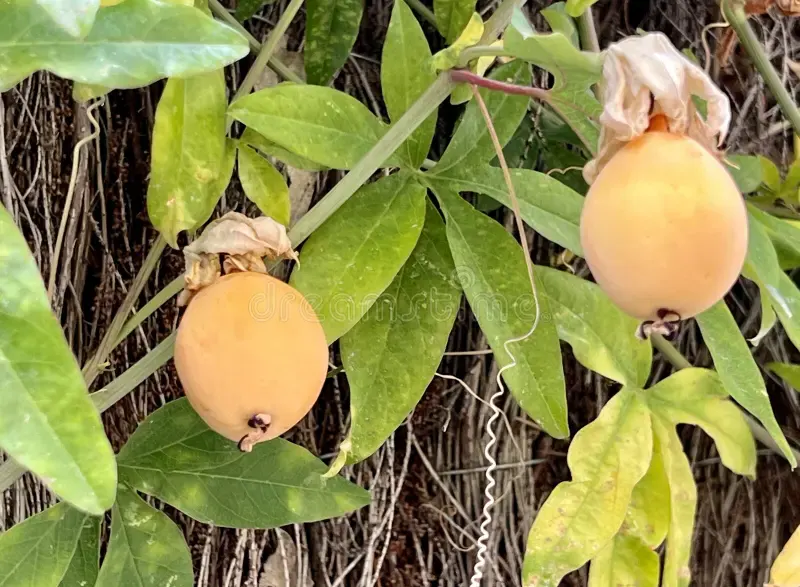
A vigorous herbaceous climber with coiling tendrils and deeply three-lobed, finely toothed leaves, dying back to the root each autumn and resprouting late the following spring. The flower settles the identification: a fringed corona of crinkled purple and white filaments over five pale petals. The fruit is egg-sized, ripening from green to dull yellow, its pulp sweet-sharp around many seeds and eaten fresh or juiced.
Not naturalised in Britain or Ireland, so encounters are garden plants or relics of old plantings, often suckering some distance from where they were set. Fruit only ripens reliably in a warm, sheltered, free-draining position such as the foot of a south-facing wall. Native to old fields and sandy roadsides in the southeastern United States.
Eat only fully ripe fruit: green fruit and the foliage contain cyanogenic glycosides and can cause stomach upset. The leafy vine is traditionally dried for tea, and that tradition carries its own caution against use in pregnancy or alongside sedative medication. In UK gardens the far commoner blue passionflower (Passiflora caerulea) is readily mistaken for it — its leaves have five to nine narrow lobes rather than maypop's three broad ones, and its fruit ripens bright orange rather than yellow; its unripe fruit is reported to cause stomach upset.
Always use more than one reference to confirm a plant. You are responsible for what you choose to forage.
Growth habit
Herbaceous rather than woody: the whole top growth dies back in autumn and new shoots appear late, often not until May or June, frequently as suckers a metre or more from the crown. A passionflower with persistent woody stems through winter is not this species.
Leaves
Alternate, palmate and deeply cut into three broad, finely toothed lobes, with a pair of nectar glands on the leaf stalk. Blue passionflower, the usual UK garden climber, has five to nine narrow finger-like lobes.
Flower
Five to eight centimetres across, with a dense fringe of crinkled, wavy filaments banded purple and white above five pale petals and sepals. The waviness of the corona filaments is distinctive; blue passionflower's are straight and blue-banded.
Fruit
Egg-shaped, four to six centimetres, hard and green for most of its life, ripening to a dull greenish-yellow and wrinkling as it softens. Firm green fruit is not ready and should be left; only wrinkled, yielding fruit has sweet pulp.
Updated 2026-08-07T21:15:19.441Z · Part of the shared Foragers Log catalogue · Fruit