Loganberry
Rubus loganobaccus
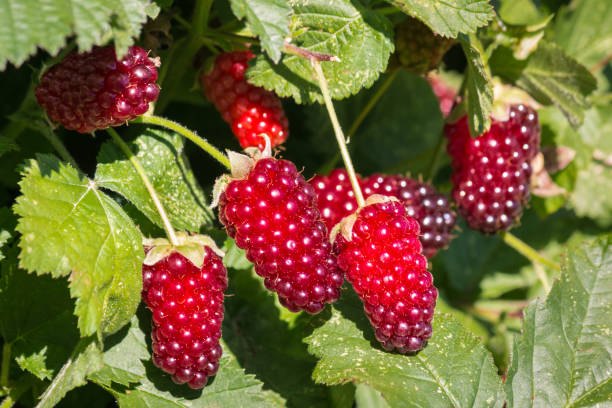
A trailing cane fruit, raised in California in 1881 from a cross between raspberry and the American dewberry Rubus ursinus. The berries are long and conical, up to about 3cm, dull wine-red rather than glossy black, and come away with the pale core still inside. Sharper and more acidic than either parent, they are usually cooked into jam, pies, cordial or wine rather than eaten out of hand.
Not a wild native. Grown in gardens, allotments and old fruit plots on deep, moisture-retentive soil in sun or light shade. It occasionally persists on hedge banks, lane sides and waste ground near where it was once cultivated, but seldom spreads far in Britain and Ireland.
No toxic parts; the fruit is eaten raw or cooked. The canes carry dense fine prickles that catch skin and clothing, so pick with covered arms. Plants on garden boundaries and roadsides may have been sprayed or be carrying traffic dust, so ask and rinse before picking.
Always use more than one reference to confirm a plant. You are responsible for what you choose to forage.
Fruit
Long and conical, 2–3cm, ripening from red to a deep dull wine-red that never blackens. It is picked with the pale core inside it, so the berry does not slip off its receptacle the way a raspberry does.
Canes
Biennial and long-trailing rather than stiffly arching, reaching 2m or more and often trained on wires. The surface is crowded with fine, soft, reddish prickles rather than the stout hooked thorns of a bramble. Fruit is carried on second-year canes.
Leaves
Pinnate with three to five leaflets, the terminal one largest, coarsely toothed and distinctly white-woolly on the underside — closer to raspberry foliage than to the greener, more palmate leaves of a bramble.
Spread
New plants come from the tips of canes rooting where they touch soil. It does not throw up suckers at a distance from the crown, which is the usual sign of raspberry in an overgrown plot.
Updated 2026-08-07T20:37:45.702Z · Part of the shared Foragers Log catalogue · Fruit