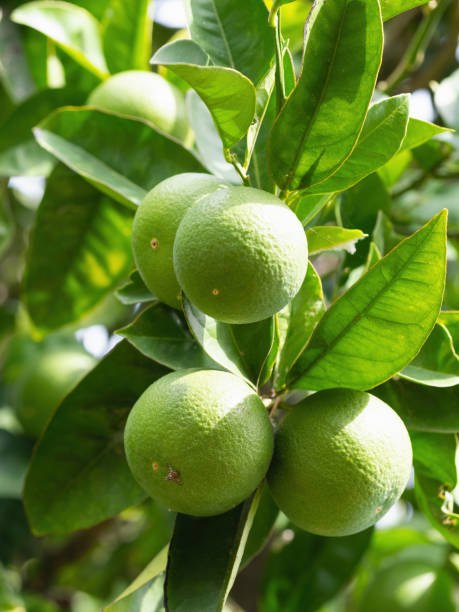
Lime
Citrus aurantiifolia
A small, densely branched thorny evergreen tree with glossy oval leaves, white flowers and thin-skinned green fruit, the juice sharper and more resinous than lemon. In Britain the name usually means Tilia, the linden or lime tree of parks and avenues; this is the citrus, an unrelated tender tropical species grown here only under glass or in a pot.
Native to tropical Southeast Asia and grown throughout the subtropics in full sun on free-draining soil. Not hardy and not naturalised in the UK or Ireland: fruiting plants here are kept in a greenhouse or conservatory above about 10°C and stood outdoors only over summer.
The fruit is eaten raw and cooked and has no known eating toxicity. Juice and peel oil contain furanocoumarins, which can cause phytophotodermatitis: a blistering burn where skin wetted with juice is then exposed to sunlight, so wash hands after squeezing. Branches carry short sharp spines.
Always use more than one reference to confirm a plant. You are responsible for what you choose to forage.
Habit and spines
A shrub or small tree to about 5 m, irregularly and densely branched, with short sharp spines in the leaf axils along most twigs. Persian lime (Citrus latifolia) is near spineless and carries noticeably larger fruit.
Leaves
Elliptical, dark green, roughly 4–8 cm long, on a leaf stalk with only a narrow wing. Citrus hystrix has a broadly winged stalk that makes each leaf look like two joined end to end.
Flowers
Small, about 2 cm across, white throughout and lightly scented, in short clusters. Lemon flowers are flushed purple-pink in bud, so a pure white bud rules lemon out.
Fruit and ripeness
Round to oval, 3–6 cm, thin-skinned and picked green while the flesh is at its most acidic. Left on the tree it pales to yellow; that is ripeness, not evidence the plant is a lemon.
Updated 2026-08-08T07:14:30.711Z · Part of the shared Foragers Log catalogue · Fruit