Kiwi
Actinidia deliciosa
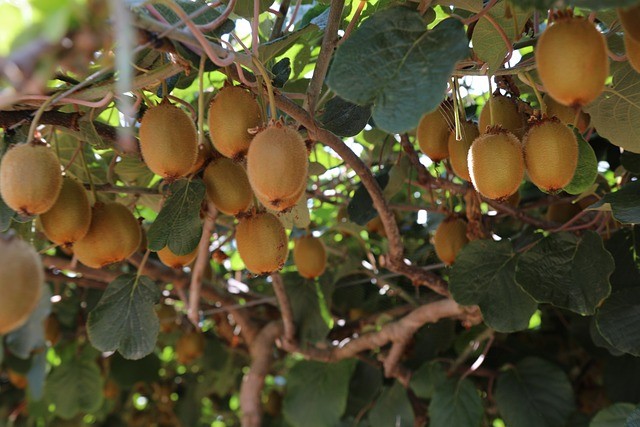
A vigorous deciduous climber with reddish, coarsely hairy young shoots and broad heart-shaped leaves, carrying egg-sized brown fruit covered in stiff bristles. The flesh is bright green, sweet-sharp when fully soft, with a ring of tiny black seeds around a pale core. Vines are usually either male or female, so fruit follows only where both are grown within reach of each other.
Not native and not naturalised in Britain or Ireland. Found as planted stock in gardens, allotments and old walled orchards, trained against sheltered south- or west-facing walls, mostly in southern England where summers are long enough to ripen a crop.
One of the more common food allergens in the UK, with reactions ranging from itching lips and throat to, rarely, anaphylaxis; people allergic to latex, banana or avocado are more likely to react. The fruit enzyme actinidain makes underripe fruit sharp and mouth-tingling if eaten in quantity. Nothing toxic in Britain resembles it, since it occurs only as planted stock.
Always use more than one reference to confirm a plant. You are responsible for what you choose to forage.
Fruit skin
Dull brown and covered in short, stiff bristles that stay rough under the thumb rather than rubbing away. Golden kiwi (Actinidia chinensis), sometimes grown on the same wall, has near-smooth bronze skin and a small beak at the tip.
Shoots and leaves
New stems are reddish and clothed in coarse red-brown hairs; the leaves are rounded to heart-shaped, up to 20cm across, and felted pale grey beneath. Hardy kiwi (Actinidia arguta) climbing nearby has smaller, glossy, essentially hairless leaves on slim stems.
Flowers
Creamy white, about 4cm across, ageing to buff, opening late spring into early summer. Male flowers show a mass of yellow stamens and no central ovary; female flowers have a pale central ovary with radiating styles. Only female vines set fruit, so a flowering plant carrying none is not a failed crop.
Ripeness test
Fruit stays rock hard on the vine and softens only in store, so firmness is no guide to when to pick. Cut one open at picking time: black seeds mean the crop will ripen indoors, pale seeds mean it was taken too early and never will.
Updated 2026-08-08T07:14:25.749Z · Part of the shared Foragers Log catalogue · Fruit