Jostaberry
Ribes nidigrolaria
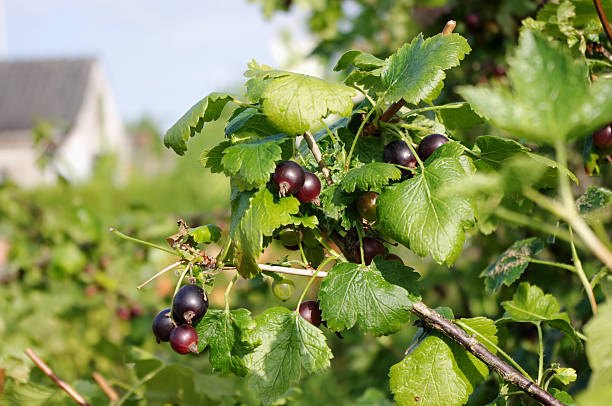
A vigorous, thornless shrub bred in Germany from blackcurrant crossed with two gooseberry species. It carries the currant's lobed leaves and the gooseberry's size and vigour, reaching about 1.5m, and bears matt purple-black berries roughly the size of a small grape in short trusses. The flavour sits between its parents: gooseberry tartness when firm, moving towards blackcurrant richness as the fruit softens. Used for jam, cordial, pies and eating fresh from the bush.
A cultivated shrub rather than a wild native, planted in gardens, allotments and community orchards across Britain and Ireland. It tolerates most soils and some shade but fruits best in full sun, and occasionally persists on abandoned plots, old hedgerow boundaries and waste ground near housing.
The fruit is safe raw or cooked and no toxic parts are recorded. Under-ripe berries are very sharp and can loosen the stomach if eaten in quantity. Because the shrub is almost always planted rather than wild, ask the landowner before picking, and rinse fruit taken from sprayed allotments or roadside plots.
Always use more than one reference to confirm a plant. You are responsible for what you choose to forage.
Habit and stems
Strong upright canes to about 1.5m, arching outwards with age. The stems are thornless throughout, which separates it at a glance from the gooseberry side of its parentage; a spiny bush with similar leaves is a gooseberry, not this.
Leaves
Three- to five-lobed and currant-shaped, but noticeably larger, thicker and glossier than a blackcurrant's, and held on longer stalks. They stay green well into autumn rather than colouring early.
Fruit
Borne in short trusses of three to five, each berry larger than a blackcurrant and smaller than a dessert gooseberry. The skin is smooth and matt purple-black with no bristles and none of the pale longitudinal veining of a gooseberry.
Ripening sequence
Berries pass from green through dull red to purple-black, and the whole truss does not ripen at once. Firm red-purple fruit is sharp and best cooked; fully black fruit that gives slightly under the thumb is sweet enough to eat raw.
Crushed leaf scent
A crushed leaf gives only a faint blackcurrant smell, far weaker than the pungent scent of a true blackcurrant leaf. A strong, unmistakable blackcurrant hit points to Ribes nigrum instead.
Updated 2026-08-07T20:37:40.834Z · Part of the shared Foragers Log catalogue · Fruit