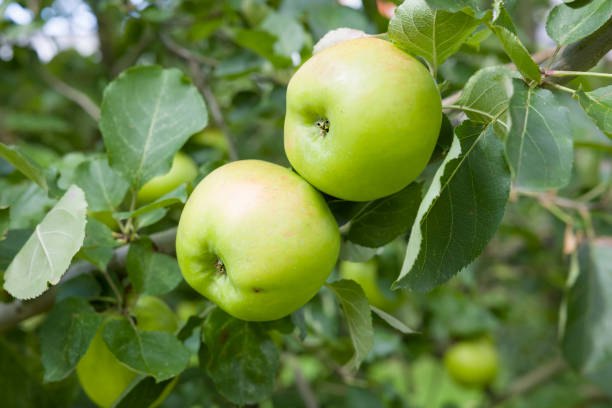
Granny Smith Apple
Malus domestica
A late-season apple with uniformly grass-green skin, small pale lenticels and a squat, faintly ribbed shape. The flesh is white, very firm and coarse-grained, with high acidity that mellows only a little in store, so it works both as a sharp eating apple and as a cooking apple that holds its shape. Raised in Australia in the 1860s and widely planted in British gardens, though it needs a long warm autumn to ripen properly here.
A cultivated tree of gardens, allotments and orchards across lowland Britain and Ireland, occasionally persisting in hedgerows and on waste ground where old plantings or discarded cores have taken. Best fruit comes from warm, sheltered sites in the south; further north the crop often stays small, hard and very acid.
Skin and flesh are safe raw and cooked. The pips contain amygdalin and release traces of cyanide if chewed in quantity, though swallowed whole they pass through; avoid repeatedly juicing whole cores. Garden and orchard trees are often sprayed, and cultivated fruit belongs to the landowner, so ask before picking.
Always use more than one reference to confirm a plant. You are responsible for what you choose to forage.
Skin
Even grass-green over the whole fruit, smooth and slightly waxy, with scattered small pale lenticels and at most a faint pink flush on the side that saw most sun. It does not develop the broad russet patches of Herefordshire Russet or the red striping of Discovery.
Fruit shape
Squat and round-conical, faintly ribbed towards the eye, with a broad open calyx and a short stout stalk sitting in a deep cavity. Fruit is medium-sized and regular rather than the large, flat-sided fruit of Bramley.
Flesh and flavour
White, dense and coarse-grained, snapping rather than crumbling when bitten, with a sharp acidity behind a light sweetness. Cooked, the slices hold their shape instead of collapsing to a purée as Bramley does.
Ripeness test
Cup the fruit, lift and twist: ripe apples part from the spur with the stalk attached. Cut one open first, the pips should be dark brown, not white. Green skin colour is no guide here, as the fruit stays green even when fully ripe.
Updated 2026-08-08T06:52:55.067Z · Part of the shared Foragers Log catalogue · Fruit